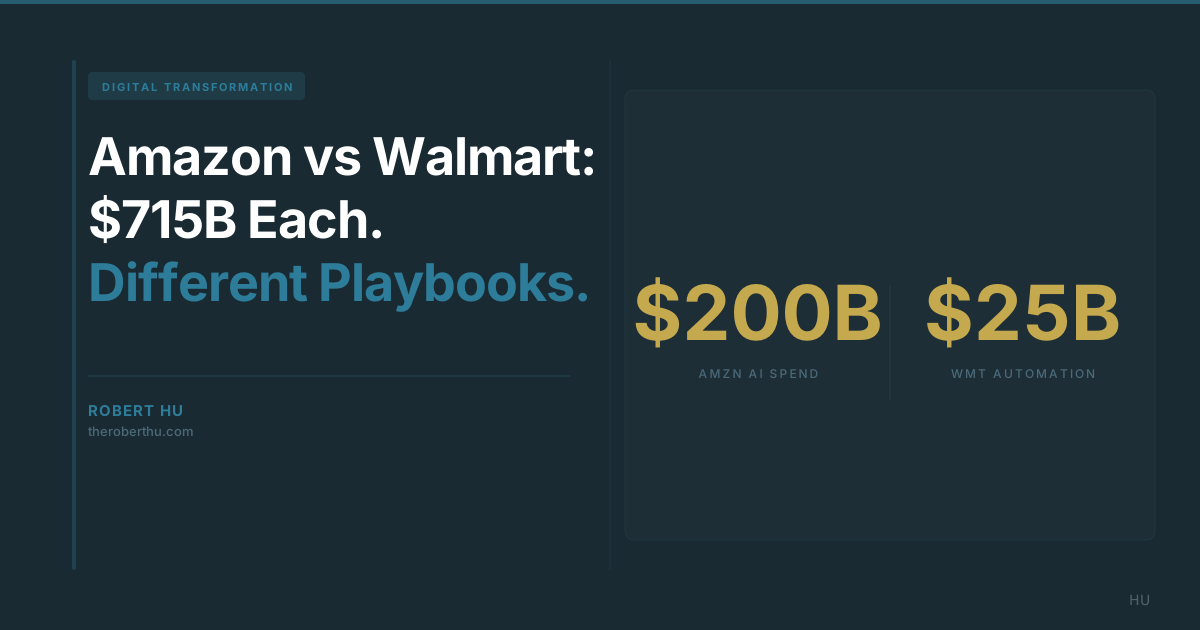
Amazon and Walmart are now the same size. Both companies are generating roughly $715 billion in annual revenue. For the first time in e-commerce history, the two dominant marketplaces are running neck and neck on the top line.
But pull back the hood on how they're spending that revenue and pursuing the next decade of growth, and you find two completely different strategies. Amazon is building a walled garden. Walmart is going open. For brands doing $100K to $2M selling on both platforms, this divergence is the most important strategic development of 2026.
Key Takeaways
- $715 billion each in annual revenue for Amazon and Walmart, but Amazon is spending $200B on AI infrastructure while Walmart is spending $25B on store automation and omnichannel.
- Amazon is going closed: Rufus, Shop Direct, Buy for Me, blocked outside AI agents. Everything inside Amazon's ecosystem.
- Walmart is going open: Sparky in ChatGPT and Gemini, Google's Universal Commerce Protocol, external ad surfaces. Everywhere shoppers ask for recommendations.
- Dual-channel brands need two different playbooks. Same product data discipline, completely different distribution strategy on each platform.
What Happened: The Revenue Parity Moment
For most of the last decade, the narrative was Amazon vs. everyone else. Walmart was the legacy retailer playing catch-up. Amazon was the digital-native disruptor. The revenue gap reinforced that story.
That gap is gone. Walmart's 2025 fiscal year hit $715 billion in total revenue. Amazon's trailing twelve months are in the same zone. The two companies are now peers, not predecessor and challenger. But the parity on revenue masks the divergence on strategy.
Look at where each company is investing. Amazon is committing roughly $200 billion to AI infrastructure: custom silicon (Trainium, Inferentia), AWS capacity expansion, Rufus development, agentic commerce tooling, and the computational layer that powers Rufus's personalized recommendation engine. Walmart is committing roughly $25 billion to store automation, fulfillment infrastructure, Walmart+ membership expansion, and the omnichannel integration that connects 4,600 physical stores to walmart.com.
Both companies are spending at historic levels. But they're spending on completely different things because they believe different things about where the next decade of retail goes.
Newsletter
Follow the research
Research notes and analysis on how AI, digital transformation, product discovery, and customer behavior are changing commerce.
Subscribe to Hu's Weekly HootWhat Is Amazon's Walled Garden Strategy?
Amazon's theory of the future: control the ecosystem. Make Amazon the place where AI-powered shopping happens. Keep the customer, the transaction, and the data inside Amazon's surfaces.
The evidence is everywhere once you look for it:
Rufus stays inside Amazon. Amazon's AI shopping assistant is available on the Amazon app and Amazon.com. It does not integrate with ChatGPT. It does not integrate with Gemini. It does not plug into any third-party AI surface. Shoppers who want AI-powered product discovery on Amazon have to come to Amazon.
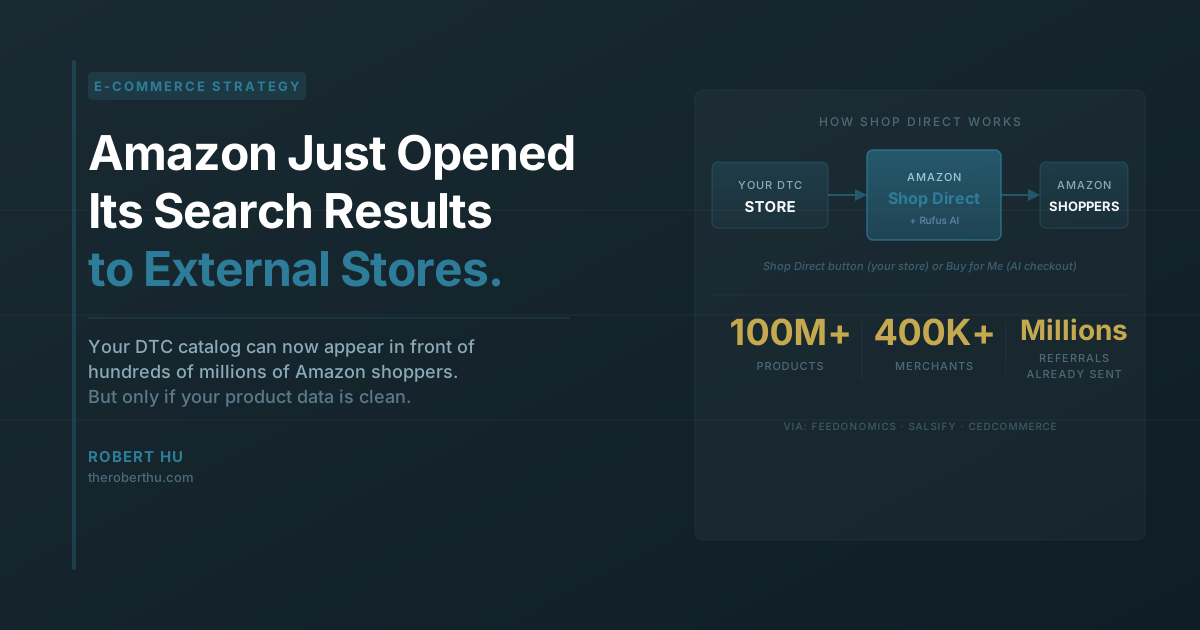
Shop Direct extends Amazon's reach without giving up control. Amazon's Shop Direct program lets Amazon customers discover products from external DTC stores inside Amazon's search results. But the discovery happens on Amazon. The checkout (via Buy for Me) happens through Amazon's AI agent. The customer relationship stays with Amazon even when the product ships from a Shopify store.
Buy for Me is Amazon's AI reaching out, not shoppers going elsewhere. Amazon's AI agent shops external sites on behalf of Amazon customers. The external store fulfills the order, but the customer thinks they bought from Amazon. It's ecosystem expansion disguised as merchant friendliness.
Amazon sued Perplexity for scraping. When Perplexity's Comet agent tried to access Amazon's product data and facilitate purchases outside Amazon's ecosystem, Amazon took them to federal court. The message was clear: outside AI agents are not welcome inside Amazon's garden.
Put these moves together and the strategy is coherent. Amazon believes the company that owns the AI layer of e-commerce owns the future of retail. Everything they're building is designed to make sure that company is Amazon.
What Is Walmart's Open Ecosystem Strategy?
Walmart's theory of the future is the opposite. Don't try to own the AI layer. Own distribution across every AI surface where shoppers might ask for recommendations.
Sparky is everywhere. Walmart's AI shopping assistant started on walmart.com, then integrated into ChatGPT and Gemini. When a ChatGPT user asks for product recommendations, Walmart products can surface through Sparky. Same for Gemini. Walmart is betting that the shopping conversation happens wherever the shopper already is, not where Walmart wants them to be.
Google's Universal Commerce Protocol (UCP) is a Walmart co-development. UCP is an open standard for AI agents to discover and transact with merchants. Walmart helped build it. The explicit goal is a world where any AI agent can interact with any retailer, using a common protocol. This is the architectural opposite of Amazon's closed approach.
Sponsored Prompts inside Sparky. Walmart is now monetizing AI shopping conversations with paid placements. Sellers can bid through Walmart Connect to appear in Sparky's AI responses. The ad surface extends wherever Sparky runs, which means potentially inside ChatGPT and Gemini too.
Physical store integration as a moat. Walmart's $25 billion in capital spending is going into store automation, automated fulfillment, and same-day delivery infrastructure built on top of 4,600 physical locations. This is something Amazon can't replicate without buying Whole Foods ten more times. Walmart's open AI strategy is supported by a physical-world moat that Amazon doesn't have.
Walmart's bet: if the AI layer becomes a commodity (because UCP and similar standards enable every AI agent to talk to every retailer), the competitive advantage shifts back to the fundamentals of retail. Price, selection, availability, delivery. That's the game Walmart has been playing for 60 years.
Why Can't You Run the Same Playbook on Both Platforms?
Because the platforms are optimizing for different outcomes, the signals that matter on each are different too.
On Amazon, your visibility is determined by how well Rufus understands your product inside Amazon's closed ecosystem. Rufus reads your listing data, your reviews, your A+ content, your Q&A section. Every signal Rufus evaluates comes from inside Amazon. If your listing is thin on structured data, Rufus skips you. If you're not optimized for the WHO/WHEN/WHERE/WHY framework, you miss the $10 billion in incremental annualized sales flowing through Rufus today.
On Walmart, your visibility is determined by how well Sparky can represent your product across multiple surfaces. Sparky has to pull your data, understand it, and present it coherently whether the query comes from walmart.com, ChatGPT, or Gemini. That means your Walmart listing needs the same data quality as Amazon, plus consistency with how your product appears on your DTC site and any other channel Sparky might pull from.
The underlying product data discipline is the same on both platforms. The distribution strategy on top of that discipline is completely different. Robert Hu has been telling the brands he works with that the two platforms now require two different operational models, not just two different ad accounts.
Best Amazon Optimization Strategy for 2026
Amazon in 2026 is a closed AI ecosystem. The brands that win are the ones who optimize for Rufus first and traditional search second.
Start with listing data completeness. Every backend attribute field, every bullet point, every A+ content module should answer the persona-specific questions that AI agents use to make recommendations. Age range, skill level, use case, material, compatibility. If Rufus can't infer it, Rufus skips you.
Invest in review quality, not just quantity. Rufus synthesizes review text. Reviews that mention specific use cases ("perfect for my 6-year-old," "works great for apartment gyms") reinforce persona relevance. You can't control review content directly, but you can influence it by selling a product that delivers on the specific use cases your listing promises.
Don't fight the walled garden. If you're selling on Amazon, you're operating inside Amazon's rules. Trying to drive Amazon shoppers to your DTC site through clever listing copy or indirect calls to action will get you suspended. Accept the ecosystem and optimize within it.
Plan for Amazon to monetize Rufus eventually. Right now Rufus recommendations are organic. But Amazon's entire business model depends on advertising revenue, and Rufus is the next frontier. When ads arrive in Rufus conversations, your organic listing data quality will determine whether your paid placements convert. GEO is the foundation. Ads will be the amplifier. This is the same pattern already playing out on Walmart's AI ad tools.
Stay on top of Rufus updates. Amazon ships Rufus improvements constantly. Monthly active users are up 149% year over year. Each update raises the bar for what "optimized" means. Brands that treat listing optimization as a one-time project fall behind. Brands that treat it as ongoing data quality work compound their advantage.
Best Walmart Optimization Strategy for 2026
Walmart in 2026 is an open AI ecosystem. The brands that win are the ones who optimize for Sparky across multiple surfaces and use WFS to secure fulfillment advantages.
Optimize for cross-surface consistency. Your Walmart listing needs to work not just on walmart.com, but inside ChatGPT and Gemini conversations. That means the same product data discipline as Amazon, plus alignment with how your product appears on your DTC site and any other channel Sparky might cross-reference.
Use Walmart Fulfillment Services (WFS) aggressively. WFS sellers get the W+ tag, faster delivery badges, and better organic search placement. They also get partial protection from the new Negative Feedback Rate metric on fulfillment-related complaints. The economics favor WFS in most categories.
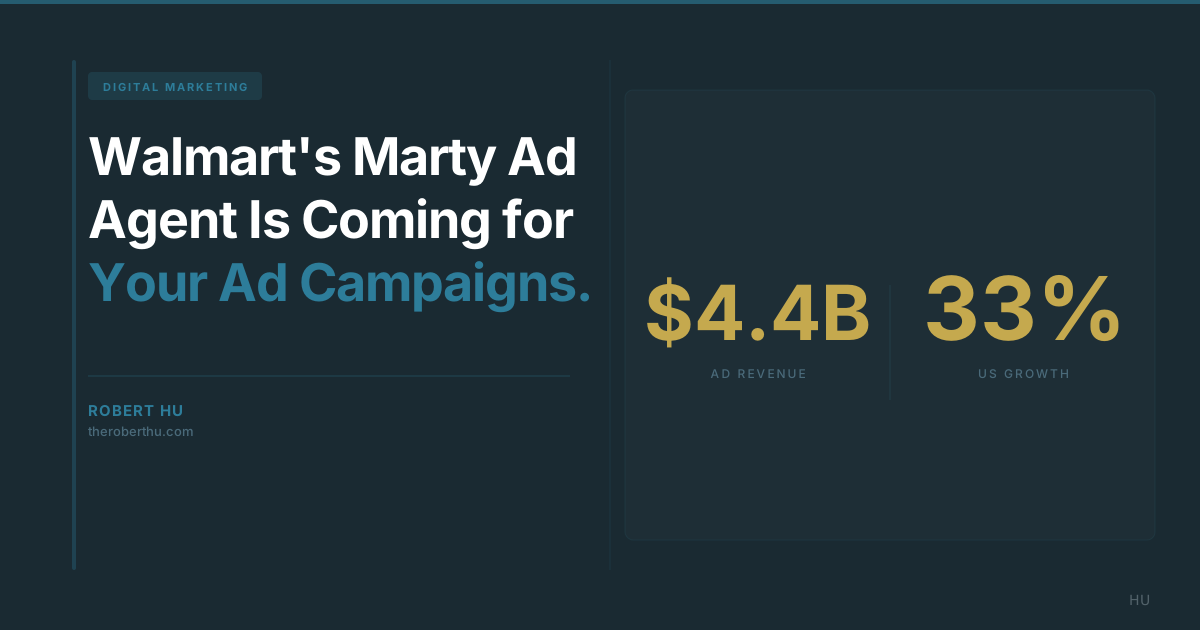
Test Walmart Connect advertising early. CPCs on Walmart are still a fraction of Amazon's in most categories. Walmart Connect revenue grew 33% in Q3 2025 compared to Amazon Ads at 24%. The auction is less mature and the early-mover advantage is real. Start with 15 to 20 percent of your total retail ad budget on Walmart for a 90-day test.
Experiment with Sparky Sponsored Prompts. This is brand new. The sellers who build category-specific data now will have a head start when the format scales. But only after your organic listing data is strong enough for Sparky to present your product coherently.
Watch the Walmart search analytics carefully. The keyword-level data Walmart now provides is a direct window into how Sparky evaluates your listing. High impressions with low clicks means your title doesn't match query intent. This is the same diagnostic that reveals GEO gaps before they become revenue gaps.
What's the Thread That Connects Both Strategies?
GEO. Same data discipline, different distribution.
Whether you're optimizing for Amazon's walled Rufus or Walmart's multi-surface Sparky, the underlying work is the same. Your product data has to answer who it's for, when to use it, where it works best, and why it solves a specific problem. That's the Generative Engine Optimization foundation.
The difference is what you do on top of that foundation. On Amazon, you double down on Amazon-native optimization because the platform is closed. On Walmart, you spread your optimization across multiple surfaces because the platform is open.
This is where most brands fail. They treat listing optimization as a checkbox on each platform ("update the Amazon listing, update the Walmart listing, done"). The brands that win treat listing optimization as an ongoing data quality discipline that feeds different distribution systems. The messy middle is being compressed by AI on both platforms, but the compression is happening through different mechanisms on each.
A Framework for Dual-Channel Brands at $100K to $2M
Here's how Robert Hu thinks about the dual-channel strategy for brands at this revenue level:
Phase 1: Audit your product data for AI readiness. Before anything else, make sure your top 10 SKUs have complete listing data on both platforms. WHO, WHEN, WHERE, WHY. Every backend attribute filled. Every bullet point written as an answer to a real shopper question. This is the shared foundation both platforms require.
Phase 2: Optimize Amazon for Rufus depth. Amazon is likely your larger channel, so prioritize the closed ecosystem. Rich A+ content, complete attributes, review quality. Invest in Amazon-specific listing optimization that assumes Rufus is the primary discovery layer. Plan for eventual Rufus ads.
Phase 3: Optimize Walmart for Sparky breadth. Your Walmart listing needs the same data quality, but also needs to work across ChatGPT, Gemini, and any future AI surface Sparky integrates with. Cross-platform consistency matters more on Walmart than on Amazon. Use WFS for fulfillment leverage.
Phase 4: Split your advertising budget accordingly. A reasonable starting allocation for a dual-channel brand is 70-80 percent Amazon, 20-30 percent Walmart. Amazon has the auction maturity. Walmart has the growth rate and lower CPCs. Adjust based on your category-specific performance data after 90 days.
Phase 5: Build operational capacity for the divergence. The two platforms now require meaningfully different operational models. Different listing formats, different ad platforms, different fulfillment integrations, different analytics tools. This is where digital transformation work pays for itself. The brands that build dual-channel operational capacity now will outperform the ones that keep running a single playbook.
The Bigger Picture
$715 billion each. Two completely different bets about how the next decade of retail unfolds. Amazon is betting on ecosystem control. Walmart is betting on open distribution. Neither approach is obviously wrong. Both could be right for different reasons. Both could reshape how your brand grows over the next 24 months.
For brands at $100K to $2M, the tactical implication is clear: you can no longer run one playbook across both platforms. The optimization that wins on Amazon is different from the optimization that wins on Walmart, even though both rest on the same product data foundation. The sooner you build operational capacity for that divergence, the better positioned you are for whichever scenario plays out.
The brands that understand this divergence and optimize accordingly will outperform the ones treating both marketplaces the same way. The brands that build dual-channel discipline now will compound their advantage as both platforms continue investing.