AI shopping agents are compressing the shopping journey from a multi-day exploration loop into a 3-second recommendation. For Amazon and Walmart sellers, this is the most significant structural change to product discovery since Google introduced paid search. And most brands have no idea it's happening to them right now.
The brands that survive this shift are not the ones with the biggest review counts or the highest PPC budgets. They're the ones whose listings contain enough context for an AI to recommend them confidently. Right now, only about 8% of Amazon listings meet that standard.
Key Takeaways
- Generative AI grew 75% as a discovery channel in the past year. AI-assisted shopping is now mainstream, not niche.
- Purchases happen 47% faster when AI assists with discovery, compressing the exploration-evaluation loop that used to take hours or days.
- Only 8% of Amazon listings have enough structured data for AI to personalize a recommendation. That gap between AI-ready and AI-invisible is the opportunity.
- 85% of shoppers are open to AI-influenced impulse purchases, but only brands with contextual, specific product data earn those recommendations.
What Was the Messy Middle?
Google named it in 2020: the messy middle describes the exploration-evaluation loop shoppers enter between a purchase trigger and an actual transaction. A shopper decides they need a meal prep container. They search. They browse 47 options. They read reviews. They compare prices. They close the tab. They come back two days later. They watch a YouTube video. They eventually buy.
That loop could last hours or weeks depending on the category. And it was the arena where e-commerce brands competed. Strong SEO got you into the loop early (page one, position one to three). Strong listing content kept you in consideration as the shopper compared alternatives. Retargeting kept your product in front of shoppers who looked but didn't buy. The entire discipline of marketplace marketing was built around surviving and winning inside the messy middle.
Understanding what a bad listing actually costs you starts with understanding how much of the messy middle you're losing before a shopper ever reaches your product detail page.
Newsletter
Follow the research
Research notes and analysis on how AI, digital transformation, product discovery, and customer behavior are changing commerce.
Subscribe to Hu's Weekly HootHow Is AI Compressing the Shopping Journey?
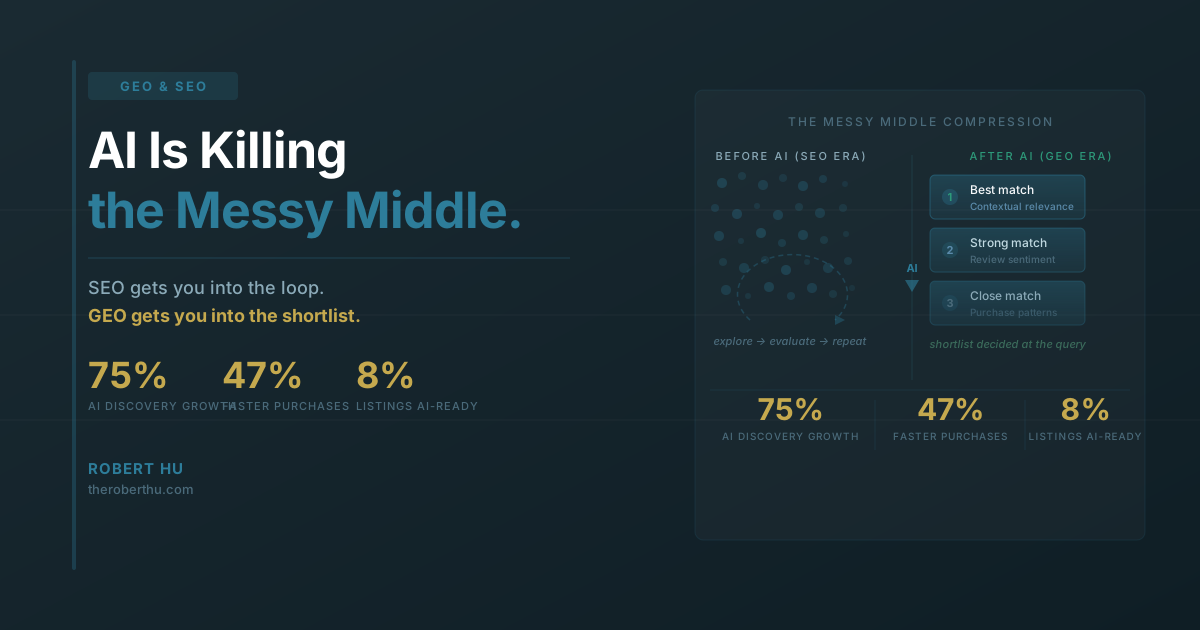
When a shopper asks Rufus "what's the best glass container for meal prep at the office," the AI doesn't return 200 results and let the shopper spiral. It returns 3 to 5 products based on data quality, review sentiment, purchase patterns, and contextual relevance to that specific query. The exploration-evaluation loop that used to take 45 minutes collapses to 30 seconds.
This matters because the messy middle was where brands with marketing budgets and aggressive bid strategies could outrun better products. Frequency of exposure built familiarity. Familiarity built trust. Trust converted. AI skips all of it. The shortlist is decided at the query, before the shopper starts spiraling, and if you're not on it, you don't exist in that transaction.
The numbers behind this shift are significant. Generative AI grew as a discovery channel by 75% in the past year. 85% of shoppers are open to impulse purchases when AI makes a confident recommendation. And purchases happen 47% faster when AI assists with discovery. The loop isn't just shorter. In many queries, it's gone.
The Compression in Numbers
- Old path: Shopper sees 47-200 results, explores for days, converts (or doesn't)
- New path: AI returns 3-5 shortlisted products, shopper decides in seconds
- The difference: 47% faster purchase, 85% open to impulse purchases (only when AI recommends you)
What Is the Difference Between SEO and GEO Through This Lens?
GEO (Generative Engine Optimization) is the practice of optimizing listings and content for AI-powered recommendation, not just keyword-based search. SEO gets your listing onto page one of hundreds of results. GEO gets your listing into an AI's shortlist of 3 to 5. They are fundamentally different outcomes that require fundamentally different content.
SEO success means your listing shows up when someone types "glass meal prep containers." You're one of 200 options. Whether the shopper picks you depends on your images, price, review count, and how you stack up in the moment they scroll. A strong SEO game guarantees visibility in the loop. It doesn't guarantee you make the shortlist.
GEO success means your listing has enough context, structure, and specificity for an AI to recommend it in response to a natural language query. The AI needs to know not just what your product is, but who it's for, when they'd use it, where they'd use it, and why it fits their specific situation better than the alternatives.
Most sellers have SEO. Almost none have GEO. That gap is the opportunity. See the full GEO optimization framework for how to build the contextual depth AI systems require.
The Rubbermaid Problem: 13,000 Reviews, Zero GEO
Here's an example that makes the stakes concrete. Rubbermaid sells glass meal prep containers with excellent reviews: 13,000+ ratings, 4.6 stars. Their SEO is strong. They show up for "glass meal prep containers" searches. Their PPC history is solid.
But ask Rufus "what's the best glass container for meal prep at the office when I'm doing Sunday batch cooking and need something that goes from fridge to microwave without staining?" and Rubbermaid may not surface. Why? Their listing doesn't answer those questions. "Office." "Sunday batch cooking." "Fridge to microwave transition." "Staining resistance." None of those contextual signals exist in searchable, structured form.
The listing was optimized for keyword-based search. It was not optimized for AI-powered query interpretation. A competing product with 200 reviews that specifically addresses those contexts will outperform Rubbermaid for that query. In a GEO world, contextual depth beats review volume for the queries where buying intent is highest.
The Quotable Take
"SEO gets you into the loop. GEO gets you into the shortlist. In an AI-powered shopping environment, only one of those matters at the moment of purchase."
Why Only 8% of Amazon Listings Are AI-Ready
Only approximately 8% of Amazon listings have enough structured data for an AI to personalize a recommendation. That means 92% of listings are invisible to Rufus for anything beyond the most basic product-category queries. They can win on "glass meal prep containers." They can't win on "glass container for the office that doesn't stain and fits in a standard work refrigerator."
The reason most listings fall short is structural. Amazon's traditional listing format was built for keyword-based search. Titles were optimized for search terms. Bullet points were written to hit features. Product descriptions were SEO copy. None of that architecture was designed to answer the natural language queries that AI agents process.
Building for AI-readability means adding a different layer of content: buyer personas, use-case specificity, situational context, and benefit language that tells an AI not just what the product is, but when and for whom it's the right answer.
For brands at $100K to $2M, the window for first-mover advantage inside AI-powered discovery is real. The competitive gap between AI-ready and AI-invisible listings is wider today than at any point in the history of Amazon SEO. And unlike review count, AI-readiness can be built in days, not years.
See how Amazon Rufus is already changing what Amazon sellers need to know and what specific changes Rufus made to surface AI-optimized listings above keyword-optimized ones.
How Do You Audit Your Listings for AI Readiness?
Robert Hu uses a four-dimension framework to evaluate whether a listing has enough contextual depth for AI-powered recommendation. Run your top five listings through this before anything else.
WHO: Does your listing identify the specific person this product is for? Not "anyone who needs meal prep containers" but "someone doing office meal prep who needs portion control and microwave-safe glass." AI agents match product recommendations to buyer context. If your listing doesn't specify who it's for, the AI can't match it to the right query.
WHEN: Does your listing describe the specific moments or situations where this product is the right choice? "Sunday batch cooking." "Post-workout meal." "5-day work week prep." These temporal and situational signals tell AI agents when your product belongs in a recommendation.
WHERE: Does your listing describe the physical or situational environments where this product performs? "Office refrigerator." "Standard microwave." "Meal bag that fits a standard tote." Without where-context, your product can't earn placement in queries that include location or environment signals.
WHY: Does your listing explain the specific mechanism that makes it better than alternatives for the right buyer? Not generic "high quality" but "borosilicate glass resists tomato-sauce staining, unlike standard glass containers." AI agents need a defensible reason to recommend one product over another. Generic benefit claims don't provide that.
If your listing can't answer all four dimensions with specific, structured language, it's not AI-ready. Review the full Rufus optimization guide for the technical content signals that drive Rufus placements specifically.
What Should Amazon and Walmart Sellers Do Right Now?
The practical sequence matters. Don't optimize for every AI surface at once. Start where the volume is.
Step 1: Identify your highest-revenue listings. These are the products where AI shortlist placement has the highest dollar impact. Start with your top five by revenue. Don't spread the optimization effort across your entire catalog at once.
Step 2: Audit for the WHO-WHEN-WHERE-WHY framework. Score each listing on all four dimensions. A listing that scores well on WHO but fails WHEN and WHERE is missing the situational context that drives Rufus recommendations for specific use cases.
Step 3: Add context, not keywords. The fix isn't adding more search terms. It's adding buyer-specific language that tells the AI exactly who this product is for and why. "For office professionals doing Sunday batch cooking" in the product description gives Rufus something to match against the right query. "Premium quality glass containers" gives it nothing.
Step 4: Monitor Rufus placement, not just keyword rank. Ask Rufus directly: "What's the best glass meal prep container for the office?" If your product doesn't surface in the top 3, your listing doesn't have enough contextual depth for that query yet. Test queries that match your actual buyer personas and iterate.
The product listing optimization work I do with brands starts exactly here: auditing the contextual gap between what your listing currently says and what an AI needs to confidently recommend it.
Frequently Asked Questions
What is the messy middle in e-commerce?
The messy middle is Google's term for the exploration-evaluation loop shoppers enter between deciding they need a product and actually buying it. Shoppers explore options, evaluate them, compare alternatives, and eventually convert. AI shopping agents compress this loop by returning 3-5 curated recommendations instead of a full results page, with research showing purchases happen 47% faster when AI assists with discovery.
How is AI compressing the shopping journey?
AI shopping agents like Amazon Rufus analyze query context, structured product data, review sentiment, and purchase patterns to surface 3-5 relevant products for a natural language query. Generative AI grew 75% as a discovery channel in the past year, and 85% of shoppers are open to impulse purchases when AI makes a confident recommendation. The exploration-evaluation loop that used to take days can now collapse to seconds.
What is GEO and how is it different from SEO for Amazon sellers?
GEO (Generative Engine Optimization) is the practice of optimizing product listings for AI-powered discovery and recommendation, not just keyword-based search. SEO gets your listing onto page one of hundreds of results. GEO gets your listing into an AI's shortlist of 3-5 products. SEO rewards keyword density and review volume. GEO rewards contextual depth, structured data, and specific answers to who the product is for, when to use it, where it fits, and why it beats alternatives for the right buyer.
How do I audit my Amazon listings for AI readiness?
Audit each listing against four dimensions: WHO (who specifically is this product for?), WHEN (what specific situations call for it?), WHERE (what environments does it fit?), and WHY (what specific mechanism makes it better for the right buyer?). Only about 8% of Amazon listings currently have enough structured data for AI to personalize a recommendation. If your listing can't answer all four dimensions with specific language, it is not GEO-optimized.