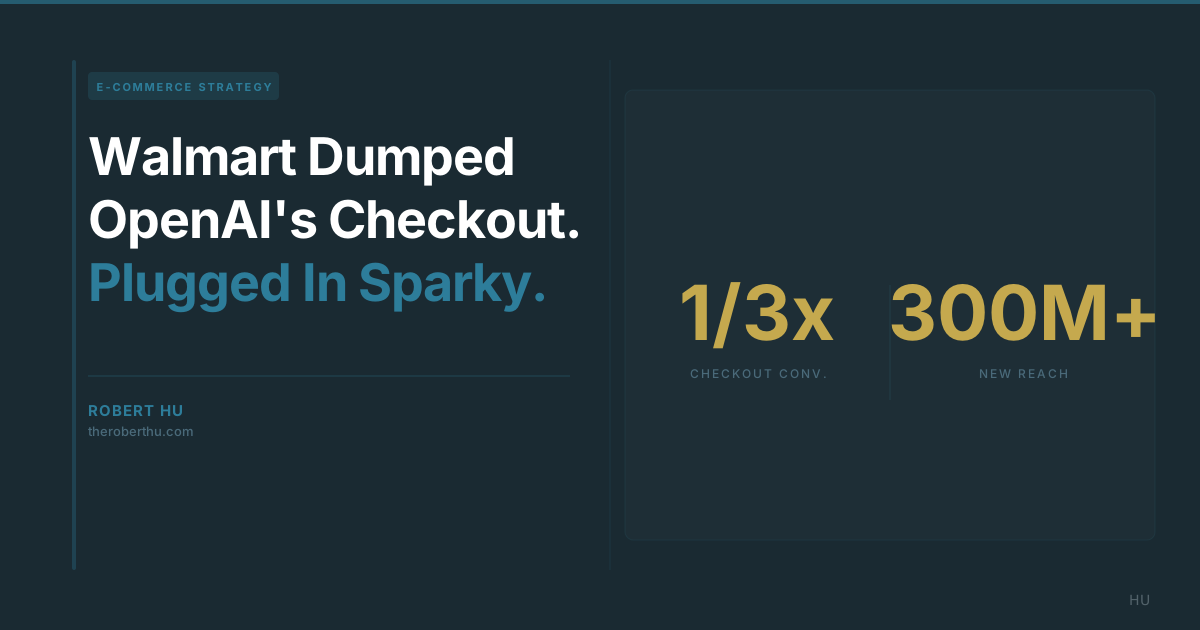
Walmart just made the most aggressive AI commerce move of 2026. After testing OpenAI's Instant Checkout inside ChatGPT and watching it produce roughly one-third the conversion rate of Walmart.com, they pulled the plug. Instead of letting OpenAI handle transactions, Walmart is embedding its own AI shopping agent, Sparky, directly into ChatGPT and Google Gemini.
Key Takeaways
- One-third conversion rate OpenAI's Instant Checkout converted at roughly 33% of what Walmart sees on its own site, with wrong items in carts and no sales tax system.
- 300+ million users Sparky is now the shopping agent inside ChatGPT and Google Gemini, extending Walmart's reach across three major platforms.
- Same GEO optimization the listing attributes that help your products surface on Walmart.com now work everywhere Sparky operates, including ChatGPT and Gemini.
- Retailers are winning both Walmart and Amazon are building their own AI agents instead of letting tech companies control the shopping experience.
For the full optimization guide, see the Walmart Sparky cluster page.
What Happened: Walmart Fired OpenAI's Checkout
Walmart tested OpenAI's Instant Checkout feature inside ChatGPT for several months. The results were bad. Conversion rates came in at roughly one-third of what Walmart generates on its own platforms. Carts were being populated with wrong items. Accuracy was a consistent problem. There was no functioning sales tax system.
So Walmart made a strategic decision. Instead of trying to fix someone else's checkout, they embedded Sparky directly into ChatGPT and Google Gemini. When a ChatGPT user asks for product recommendations, Sparky now handles the entire experience: product discovery, selection, cart building, and transaction.
Newsletter
Follow the research
Research notes and analysis on how AI, digital transformation, product discovery, and customer behavior are changing commerce.
Subscribe to Hu's Weekly HootWhy Did Instant Checkout Fail?
OpenAI built Instant Checkout as a generalized shopping layer. The problem is that e-commerce checkout is not a generalized problem. It requires deep integration with inventory systems, pricing rules, promotional logic, sales tax calculation, and return policies. Every retailer handles these differently.
Walmart's checkout on Walmart.com is the product of years of engineering, millions of transactions, and tight integration with their fulfillment network. OpenAI was trying to replicate that with an API wrapper. The one-third conversion rate tells you everything. Shoppers were getting wrong items in their carts, prices weren't matching, and the experience broke the trust that Walmart has built with its customers.
This is the same pattern we saw when ChatGPT initially tried to add checkout across multiple retailers. As I wrote in my analysis of ChatGPT's shopping pullback, AI chatbots are excellent at discovery but consistently struggle with the transactional layer. Checkout requires precision. AI conversation is probabilistic. Those two things don't mix well.
What Is the New Model? Own the Agent, Rent the Distribution
This is the most important strategic shift. Walmart is not abandoning AI-powered shopping. They're taking control of it.
Under the old model, OpenAI owned the agent (ChatGPT) and the checkout. Walmart was just a product catalog being accessed by someone else's system. Under the new model, Walmart owns the agent (Sparky) and plugs it into someone else's distribution (ChatGPT, Gemini). OpenAI and Google provide the audience. Walmart provides the shopping intelligence, the transaction, and the customer data.
This is the playbook Robert Hu has been tracking across the entire e-commerce landscape. Amazon did it by blocking outside AI agents and building Rufus and Shop Direct. Walmart is doing it by letting its own agent travel to where the users are. Different strategies, same conclusion: the retailer that controls the shopping agent controls the customer relationship.
What Does This Mean for Walmart Marketplace Sellers?
For sellers on Walmart Marketplace, this is a significant expansion of your distribution surface.
Sparky was previously confined to Walmart.com and the Walmart app. Now it operates inside ChatGPT (300+ million monthly users) and Google Gemini. When a ChatGPT user says "find me the best wireless earbuds under $50," Sparky is the engine that decides which products to recommend. When a Gemini user asks for school supply recommendations, Sparky surfaces the results.
Your product listings on Walmart.com are now the source catalog for shopping recommendations across three major platforms. If your listings are optimized for Sparky, your products just got distribution to hundreds of millions of additional users without you spending a dollar on new advertising. If your listings are thin, missing key attributes, or poorly structured, you're invisible on all three platforms simultaneously.
We already know that Sparky drives 35% higher order values on Walmart.com. That same lift now extends to every platform where Sparky operates. One catalog, three distribution channels, all powered by the same AI agent. The quality of your Walmart listing data is now directly tied to your visibility in ChatGPT and Gemini.
Sparky doesn't recommend brands. It recommends data. The brands getting picked have clean catalogs, structured attributes, and ICP-aligned positioning. The 6-dimension GEO framework scores exactly this. See the framework →
How Does Sparky Optimization Work Across Platforms?
The same Generative Engine Optimization (GEO) principles that help your products rank well with Sparky on Walmart.com now extend to every platform where Sparky operates.
Sparky reads your product titles, descriptions, attributes, and rich content. It uses this data to match shopper queries with products. The richer and more structured your listing data, the more confidently Sparky can recommend your product.
Here's what matters for GEO readiness:
- Complete product attributes. Every field Walmart gives you should be filled. Sparky uses these attributes to filter and match products to specific queries.
- Natural language descriptions. Write descriptions that answer questions a shopper would ask, not keyword-stuffed marketing copy.
- Accurate categorization. Sparky needs to know what your product is. Wrong categories mean wrong recommendations.
- Competitive pricing with context. Sparky evaluates value, not just price. Products with clear value propositions get recommended over cheaper alternatives.
The difference now is that optimizing for Sparky once gives you reach across Walmart.com, ChatGPT, and Gemini.
How Does This Compare to Amazon's Approach?
Amazon and Walmart have taken opposite strategies to achieve the same goal: owning the AI shopping experience.
Amazon's approach is a walled garden. They blocked Perplexity's AI agent from accessing Amazon data, then built Rufus (their own AI assistant) and Shop Direct (letting DTC brands appear in Amazon search results via their own AI agent). Everything stays inside Amazon's ecosystem.
Walmart's approach is an expanding network. They're sending Sparky out into the world. Instead of keeping shoppers locked inside Walmart.com, they're meeting shoppers wherever they already are: in ChatGPT conversations, in Gemini searches, on the Walmart app.
Both strategies share the same core principle: the retailer controls the shopping agent. Amazon won't let anyone else's AI sell on Amazon. Walmart won't let anyone else's AI sell Walmart products. The only difference is where the shopping happens.
For sellers on both platforms, this means two things. First, you need your listings optimized for Rufus on Amazon AND Sparky on Walmart. Second, the GEO skills that help you with one will help you with the other. Both AI agents read structured product data. Both favor complete, accurate, well-organized listings. Both penalize thin content.
The Pattern: Retailers Are Winning the AI Commerce War
Take a step back and look at what has happened in 2026.
OpenAI tried to build a universal checkout. It failed. Perplexity tried to build an AI shopping agent that worked across retailers. Amazon blocked it. Google tried to make Gemini a shopping destination. Walmart is now supplying the shopping intelligence instead of letting Google build it.
The pattern is clear. AI companies are great at building conversation interfaces. Retailers are great at building shopping infrastructure. Every time an AI company tries to handle the transaction layer, it underperforms. Every time a retailer plugs its own AI into a conversation interface, it works better.
This is not a temporary situation. Checkout, inventory, fulfillment, returns, sales tax, customer service, and trust are competencies that take decades to build. No AI company is going to replicate Walmart's supply chain with a large language model.
The winners of AI-powered commerce will be the retailers who build their own shopping agents and distribute them everywhere. Walmart with Sparky. Amazon with Rufus. The tech companies will provide the audience. The retailers will provide the commerce.
What Should Sellers Do Right Now?
If you sell on Walmart Marketplace, here are the immediate actions:
- Audit your listing completeness. Run through every product and fill in every available attribute field. Sparky uses these for matching across all platforms.
- Rewrite descriptions for conversational queries. Think about how someone would ask ChatGPT for your product. "Find me a lightweight carry-on bag under $100," not "premium luggage high quality."
- Check your pricing and value story. Sparky recommends products that represent good value. Make sure your listings communicate why your product is worth the price.
- Monitor your Sparky visibility. As Walmart's AI analytics evolve, track how often your products are being recommended through Sparky. This is a new metric that will matter more than traditional search rank.
Related reading
- Rufus Is Driving $10B for Amazon. Sparky Is Lifting AOVs 35% for Walmart.
The revenue context: $10B Rufus, 35% Sparky AOV lift, and why data quality is the gating factor. - Meta's Hatch and the Instagram Shopping Agent: What Marketplace Sellers Need to Know
Meta's parallel agentic shopping play and the Instagram catalog audit it triggers. - GEO vs SEO: What Marketplace Sellers Need to Stop Doing in 2026
The five SEO tactics that actively hurt AI visibility, with the GEO replacements that compound across surfaces.
If your Walmart listings aren't structured for Sparky, you're now invisible on three platforms instead of one.
Curious whether your brand is surfacing in Sparky's recommendations? Get a free RecoScope snapshot and see your brand's coverage across the AI shopping engines that matter.