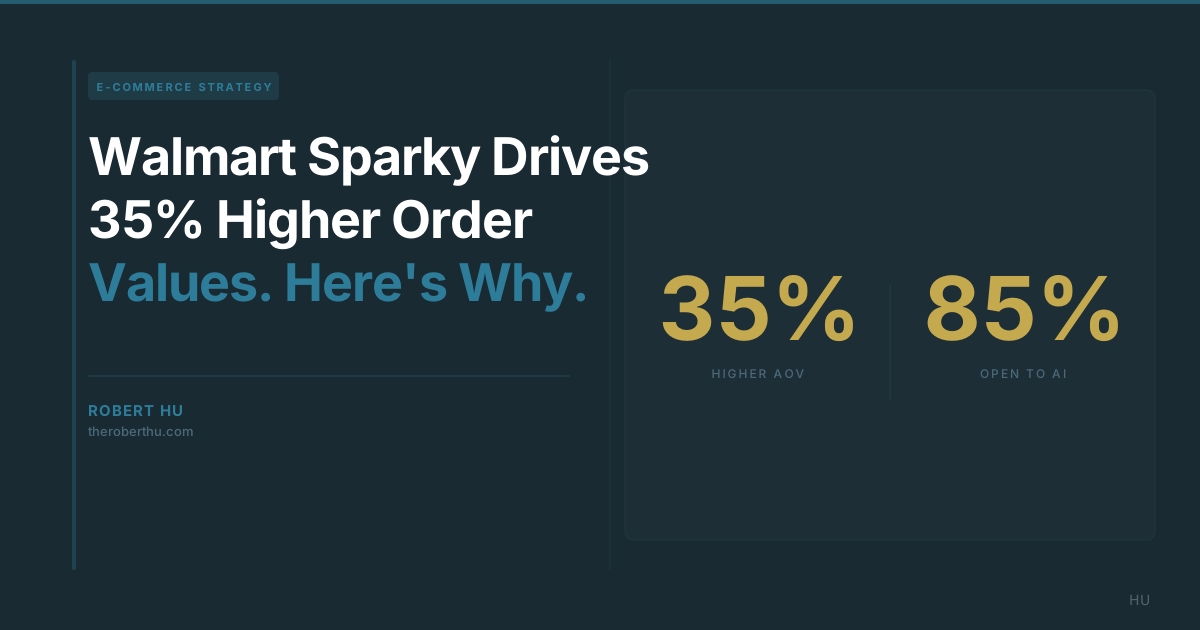
Walmart just dropped the first hard revenue number proving that AI shopping assistants directly increase sales. On the Q4 2026 earnings call, Walmart CEO John Furner revealed that Sparky, Walmart's AI shopping assistant, drives 35% higher average order values compared to non-Sparky sessions. Half of all Walmart app users have already tried it.
For Walmart marketplace sellers, the math just changed. If Sparky users spend 35% more per order, the products Sparky recommends are capturing a disproportionate share of that spend.
Key Takeaways
- 35% higher average order values for Walmart shoppers using Sparky, per CEO John Furner on the Q4 2026 earnings call.
- 50% of Walmart app users have already tried Sparky.
- Intent-driven commerce is replacing keyword search on Walmart.
- Sellers with complete, structured product data will capture the lion's share of Sparky-driven revenue.
What Happened: The 35% Stat and Why It Is the First Real Proof
On Walmart's Q4 2026 earnings call, CEO John Furner shared that shoppers who use Sparky have 35% higher average order values than those who do not. Walmart US CEO Dave Guggina added that Sparky is helping the company "evolve from traditional search to intent-driven commerce." Half of Walmart app users have already engaged with the assistant.
This matters because it is the first time a major retailer has published concrete revenue data tied to an AI shopping assistant. 35% higher AOV is not incremental. It is transformational.
For context, a seller averaging $50 per order would see Sparky-influenced orders averaging $67.50. Across thousands of transactions, that gap compounds into serious revenue.
Newsletter
Follow the research
Research notes and analysis on how AI, digital transformation, product discovery, and customer behavior are changing commerce.
Subscribe to Hu's Weekly HootWhat Does Walmart Sparky Actually Do?
Sparky is Walmart's AI shopping assistant, embedded directly in the Walmart mobile app. Instead of typing keywords and scrolling results, shoppers have natural conversations about what they need.
Examples of what Sparky handles:
- "High-protein groceries under $150 for the week" returns a curated grocery basket
- "Birthday party supplies for a 7-year-old who likes dinosaurs" builds a themed bundle across categories
- "Compare these two air fryers for a family of four" summarizes reviews and specs side by side
- "What do people say about this mattress for back pain?" synthesizes review sentiment into a direct answer
Sparky draws on the shopper's location, dietary preferences, purchase history, and Walmart+ membership status to personalize recommendations.
How Does Sparky Decide Which Products to Recommend?
Sparky does not work like traditional search. It understands intent and matches products to outcomes. Based on how conversational AI systems work and what Walmart has disclosed, Sparky prioritizes products based on several factors:
- Catalog completeness. Every product attribute matters. Missing attributes mean your product gets skipped.
- Review depth and quality. Products with detailed, specific reviews give Sparky better material to work with.
- Content that answers questions. Clear statements about what the product does, who it is for, and how it compares.
- Category and use-case relevance. Sparky thinks in terms of outcomes, not product categories.
AI shopping assistants reward products with rich, structured, outcome-oriented content. They penalize thin listings and keyword-stuffed titles.
What Does "Intent-Driven Commerce" Actually Mean for Sellers?
Dave Guggina's phrase, "evolve from traditional search to intent-driven commerce," is the most important strategic statement Walmart has made this year.
Traditional search: Shopper types "running shoes." Walmart returns hundreds of results. Sellers compete on keyword optimization and PPC bids.
Intent-driven commerce: Shopper tells Sparky "I need trail running shoes for muddy conditions, wide feet, under $120." Sparky returns 3 to 5 specific recommendations. Sellers compete on product-market fit, data completeness, and review quality.
Both Major Marketplaces Are Going All-In on AI Shopping
Amazon's Rufus AI assistant now handles over 13% of all Amazon searches using semantic understanding instead of keyword matching. Google is embedding AI-powered product recommendations directly into search results.
Every major commerce platform is replacing keyword search with conversational AI. Walmart is just the first to publish the revenue impact.
This is exactly what Generative Engine Optimization (GEO) addresses: making your products and brand visible in AI-driven discovery across every platform.
5 Things Walmart Sellers Should Do Today to Show Up in Sparky
1. Audit every product attribute in Walmart Seller Center
Fill in every single attribute field. AI assistants rely on structured data to match products to complex queries. If an attribute field exists and yours is blank, you are invisible for queries that reference it.
2. Rewrite bullet points as answers to shopper questions
Stop writing bullets like "Premium quality stainless steel construction." Start writing bullets like "Made from 18/10 stainless steel that resists rust and is dishwasher safe for easy cleanup after family meals."
3. Build your review profile with depth, not just volume
A product with 50 detailed reviews describing specific use cases will outperform a product with 500 generic "five stars, love it" reviews in an AI-driven environment.
4. Add explicit use cases to your product descriptions
If your product works for meal prep, hiking, back-to-school, or hosting, say so explicitly. Sparky matches products to outcomes.
5. Monitor your category's Sparky results weekly
Open the Walmart app, engage with Sparky, and search for the kinds of queries your target customer would use. This is free competitive intelligence.
The Bigger Picture: AI Commerce Is Not Coming. It Is Here.
Walmart just answered the debate with a 35% revenue lift and 50% adoption. The debate is over.
The appointment of Dave Guggina as Walmart US CEO signaled that Walmart was betting big on AI-powered commerce. The Sparky numbers confirm the bet is paying off. For marketplace sellers, product listing optimization now means optimizing for AI assistants, not just search algorithms.
"When a platform can prove that AI drives 35% more revenue per order, every investment in AI-friendly optimization pays for itself."