Walmart just made the move everyone expected: Sponsored Prompts inside Sparky. When a customer asks Sparky for product recommendations, some of those recommendations will now be paid placements. AI shopping conversations are officially an ad surface.
For marketplace sellers doing $100K to $2M, this changes your Walmart advertising strategy. You're no longer just bidding on search keywords. You're bidding on AI conversations. And the rules for winning those conversations are different from traditional Sponsored Search.
Key Takeaways
- Sponsored Prompts are live. Walmart is placing paid product recommendations inside Sparky's AI shopping conversations, mixed with organic recommendations.
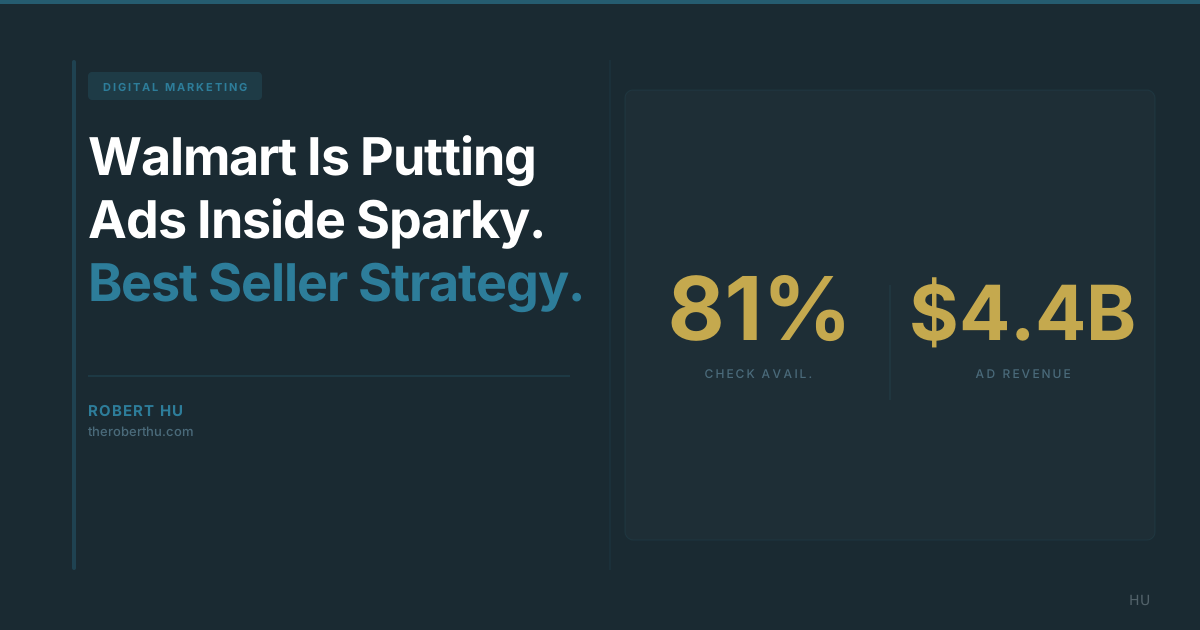
- 81% of Sparky users check product availability before buying. These are high-intent shoppers, making Sponsored Prompts a premium ad surface.
- Amazon Rufus is still organic. Walmart is the first major marketplace to monetize AI assistant recommendations with ads. Amazon will likely follow.
- Best strategy: GEO first, ads second. Sponsored Prompts still require clean listing data. Sparky can't serve a relevant ad for a product it doesn't understand.
What Did Walmart Just Launch?
Walmart Connect (Walmart's advertising platform) is rolling out Sponsored Prompts to Sparky. Here's how it works:
A customer opens the Walmart app and asks Sparky something like "what's the best protein powder for post-workout recovery?" Sparky generates a response with product recommendations. Previously, all of those recommendations were organic, based on Sparky's evaluation of listing data, reviews, and relevance signals. Now, some of those recommendations are paid placements from sellers who bid through Walmart Connect.
The sponsored results are labeled, similar to how Sponsored Products appear in traditional search. But the context is different. In search, sponsored results sit alongside a page of 48 organic listings. In a Sparky conversation, sponsored results sit alongside 3 to 5 organic AI recommendations. The real estate is smaller. The attention is more concentrated. And the shopper has already stated their intent in natural language.
That last point matters. Sparky users spend 35% more per order and 81% check product availability before purchasing. These aren't browsers. They're buyers who told an AI exactly what they want. Sponsored Prompts put your product directly into that high-intent conversation.
Newsletter
Follow the research
Research notes and analysis on how AI, digital transformation, product discovery, and customer behavior are changing commerce.
Subscribe to Hu's Weekly HootHow Does This Compare to Amazon's Approach?
Amazon and Walmart are taking different paths with AI advertising, and the difference matters for your strategy.
Amazon Rufus: still organic. As of early 2026, Rufus recommendations are entirely organic. When a customer asks Rufus a question, the response is based on listing data quality, reviews, and relevance. There are no paid placements in Rufus conversations. Amazon has not announced plans to change this, though most industry watchers expect advertising in Rufus eventually.
Walmart Sparky: now hybrid. Sparky mixes organic AI recommendations with Sponsored Prompts. Walmart is the first major marketplace to monetize AI shopping conversations with paid ads. This is consistent with Walmart's broader advertising push. Sparky is already integrated into ChatGPT and Gemini, extending its ad surfaces beyond walmart.com.
For dual-channel sellers, this means your optimization strategies are now different on each platform. On Amazon, pure GEO wins. Your listing data quality determines whether Rufus recommends you. On Walmart, it's GEO plus paid. Your listing data determines whether Sparky recommends you organically, and Sponsored Prompts let you buy your way into conversations where you don't rank organically.
But here's the nuance most sellers will miss: the paid path still depends on the organic foundation.
Why Does Listing Data Matter Even More for Paid Placements?
Sponsored Prompts aren't display ads. You're not just buying an impression on a page. You're buying a placement inside an AI conversation where the shopper has stated a specific need. Sparky has to make your product fit that conversation.
If a customer asks "best glass containers for meal prep" and your Sponsored Prompt fires, Sparky needs to present your product as a relevant answer to that question. If your listing says "Glass Storage Container Set, 5-Pack, BPA-Free" and nothing about meal prep, the recommendation feels disconnected. The customer sees a sponsored result that doesn't match their query. They skip it. You paid for an impression that didn't convert.
Compare that to a listing that says "Glass meal prep containers with snap-lock lids, 5 compartments for portion control, microwave and dishwasher safe." Sparky can naturally weave that into a response about meal prep containers. The sponsored placement feels like a genuine recommendation, not an ad.
This is why the GEO framework isn't just for organic visibility. It's the foundation for paid AI advertising too:
- WHO: If Sparky can't tell who your product is for, it can't match your sponsored placement to the right shopper persona.
- WHEN: If your listing doesn't include use-case timing (post-workout, morning routine, weekly meal prep), Sparky can't serve your ad in conversations about those scenarios.
- WHERE: Location context (home gym, outdoor, office) helps Sparky match sponsored placements to situational queries.
- WHY: The reason your product solves a specific problem is what makes a sponsored recommendation feel relevant instead of intrusive.
Paying for a Sponsored Prompt with a vague listing is like paying for a billboard with no message. The impression happens. The conversion doesn't.
What's the Best Strategy for Marketplace Sellers?
Robert Hu's recommendation for brands doing $100K to $2M on Walmart: GEO first, ads second. Here's the sequence:
Step 1: Fix your listing data. Before spending a dollar on Sponsored Prompts, make sure your top 5 to 10 listings answer the WHO, WHEN, WHERE, and WHY questions for every relevant query in your category. Complete every backend attribute. Rewrite bullets as answers to real shopper questions. Add use-case context to A+ content. This is the foundation your ad strategy builds on.
Step 2: Earn organic Sparky recommendations. Once your listings are AI-ready, monitor whether Sparky recommends your products for relevant queries. Ask Sparky about your product category in the Walmart app. If you show up organically, that's your baseline. If you don't, your listing still has gaps to fix before ads will work effectively.
Step 3: Layer Sponsored Prompts on top. Use Sponsored Prompts for two purposes. First, bid on queries where you rank organically but a competitor's sponsored placement pushes them above you. Second, bid on adjacent queries where your product is relevant but you don't rank organically yet (for example, a protein powder brand bidding on "best recovery drink" even though their listing is categorized under supplements).
Step 4: Measure differently than Sponsored Search. Sponsored Prompt performance should be evaluated differently from traditional Sponsored Search. The conversion context is different (AI conversation vs. keyword search), the shopper intent is more specific, and the click-to-purchase path is shorter. Track ROAS separately for Sponsored Prompts versus Sponsored Search and Sponsored Products. Don't blend them.
What Does This Mean for Your Walmart Connect Budget?
If you're already spending on Walmart Connect, expect CPCs on Sponsored Prompts to start low and climb quickly. Early adopters on any new ad format get favorable economics because competition is thin. That window is open now but it closes as more sellers discover the format.
The best approach for budget allocation:
- Don't shift budget from Sponsored Search to Sponsored Prompts. They serve different functions. Sponsored Search captures keyword intent. Sponsored Prompts capture conversational intent. They're complementary, not substitutes.
- Start with 10 to 15% of your Walmart ad budget on Sponsored Prompts. Enough to gather meaningful data, not enough to risk your overall ROAS if performance is uneven in the early rollout.
- Bid on your strongest product-query matches first. Don't spray budget across every category keyword. Pick the 5 to 10 queries where your listing data is strongest and Sparky can genuinely present your product as a relevant answer.
- Monitor the Amazon advertising landscape for signals. When Amazon adds ads to Rufus (and it will), the playbook you build on Walmart Sponsored Prompts will transfer directly. Getting the strategy right on Walmart now gives you a head start on Amazon later.
The Bigger Picture
Walmart putting ads inside Sparky is the beginning of a shift that will hit every platform. AI shopping conversations are the new search results page, and advertising will follow the attention. Google is already building agentic commerce. Amazon will monetize Rufus eventually. ChatGPT is becoming a shopping platform with retailer apps.
The sellers who win in this new landscape are the ones who understand that AI advertising and AI optimization are not separate disciplines. They're layers of the same strategy. Your listing data quality determines whether organic AI recommends you. That same data quality determines whether paid AI placements convert. GEO is the foundation. Ads are the amplifier. Without the foundation, the amplifier has nothing to work with.