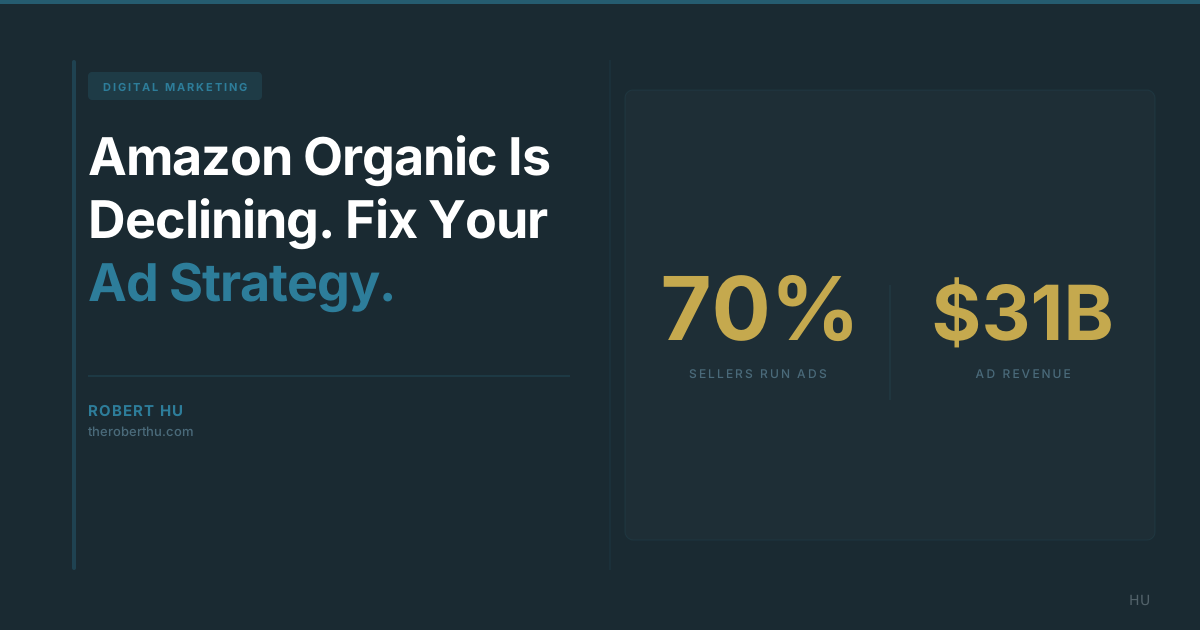
Organic visibility on Amazon is declining. Five years ago, 40% of Amazon sellers ran sponsored ads. Today that number is over 70%, and sponsored placements now dominate above-the-fold results for most high-intent searches before a single organic listing appears.
If you're a brand doing $100K to $2M and relying on organic ranking alone, a growing share of your potential customers never sees you. The answer, though, is not to simply spend more on ads.
Key Takeaways
- Over 70% of Amazon sellers now run ads (up from 40% five years ago), making paid placement essential for above-the-fold visibility on competitive searches.
- A 1% improvement in conversion rate can reduce your effective cost per acquisition by 15-20% without changing a single bid.
- Brands spending 8-12% of revenue on ads with strong listing fundamentals consistently outperform brands spending more with weak listings.
- Amazon Rufus is creating a new organic discovery channel that reduces ad dependence for brands with AI-optimized listings.
Why Is Amazon Organic Visibility Declining?
Amazon's search results page has changed structurally. Sponsored Product and Sponsored Brand placements now regularly occupy the top four to six slots on high-intent searches. What used to be prime organic real estate is now pay-to-play territory for most established categories.
The sellers who ranked on page one through strong review velocity, optimized titles, and sales history alone still exist. They're concentrated in low-competition niches. In any established product category, that playbook has a ceiling, and that ceiling has been getting lower every year.
This isn't Amazon being hostile to sellers. It's Amazon monetizing its marketplace the same way Google monetized search. The question is not whether to accept this reality. It's how to compete within it without surrendering your margins.
Newsletter
Follow the research
Research notes and analysis on how AI, digital transformation, product discovery, and customer behavior are changing commerce.
Subscribe to Hu's Weekly HootWhy More Ad Spend Isn't the Answer
I've seen brands double their ad spend in response to declining organic visibility and end up less profitable than when they started. The mechanism is simple: if your listing isn't converting the traffic, you're paying Amazon to drive window shoppers who don't buy.
Ads amplify what's already working. They don't fix what's broken. A listing with weak images, vague bullets, and no A+ content will not become a strong listing because you increased your bids. It will become an expensive underperforming listing.
The real cost of this mistake isn't just the wasted ad spend. It's the opportunity cost of what that budget could have returned on a listing that was actually ready to convert.
The Conversion Rate Math Every Amazon Seller Should Know
Here is the number that reframes your entire ad strategy. A listing converting at 8% with a $1.50 CPC on a $30 product means you're paying roughly $18.75 in ad spend to generate one sale. Fix the listing so it converts at 15%, and that number drops to $10.00 per sale, a 47% reduction in your cost per acquisition, from changing nothing about your bids.
The Math
- 8% CVR at $1.50 CPC: 12.5 clicks per sale x $1.50 = $18.75 cost per acquisition
- 15% CVR at $1.50 CPC: 6.7 clicks per sale x $1.50 = $10.00 cost per acquisition
- Difference: $8.75 saved per sale. On 500 monthly ad-driven sales, that's $4,375/month in margin recaptured.
Your conversion rate is the multiplier on every dollar you spend in ads. A brand at 15% CVR with a $10,000 monthly ad budget is playing a fundamentally different game than a brand at 8% CVR with that same budget. The fix that moves the needle is the listing, not the bid.
Understanding the real cost of a bad Amazon listing starts with this math.
Listing Optimization Has to Come Before Ad Optimization
The order matters more than most brands realize. Running ads to an underperforming listing is the equivalent of paying for foot traffic to a store with no clear pricing and bad lighting. The traffic shows up, looks around, and leaves.
Listing optimization means the title answers the top purchase question in the first seven words. The bullets lead with benefits, not feature specs. The images show the product in use, not just isolated on white. The A+ content closes the sale for the buyer who is still deciding.
Only once those elements are tested and working should you scale ad spend. Otherwise you're compounding a conversion problem with more traffic. Fill the holes in the bucket before you turn up the tap.
Robert Hu has spent over 20 years watching brands make this mistake in sequence: they hire an ad agency, see flat results, blame the agency, and only then discover the real problem was the listing. The right sequence saves months of wasted spend. See what a proper product listing optimization audit actually covers.
How Rufus and AI Search Change the Ad Equation
Amazon's Rufus AI is changing the organic discovery landscape in a way that creates a real opportunity for brands who understand it. Rufus surfaces product recommendations based on semantic understanding of what a product is, what it does, and who it's for. It doesn't rely on keyword matching the way traditional organic search does.
This means a listing optimized for AI readability can earn placement inside Rufus recommendations without any ad spend. For brands investing in listing content quality right now, Rufus is a compounding asset. Every dollar you put into listing quality earns returns on both the ad side (better conversion rate, lower effective CPC) and the organic side (Rufus recommendations).
The long-term effect: brands that treat listing content as a strategic asset will see TACoS (Total Advertising Cost of Sales) decline over time as Rufus drives more unassisted discovery. Brands that treat listing content as a checkbox will stay ad-dependent indefinitely. See the full breakdown of how to optimize your listings specifically for Rufus.
A Simple Ad Framework for Brands Doing $100K to $2M
For brands at this revenue range, the right system has three layers. Work through them in order.
Layer 1: Listing audit before budget allocation. Before committing any meaningful ad spend, score your top five listings against conversion fundamentals. Title clarity, benefit-led bullets, image quality, A+ content, review count, and recency. If more than two of those are weak, fix them first.
Layer 2: Start narrow on targeting. Launch with Exact Match campaigns targeting your 10 to 15 highest-intent keywords. Do not run Broad Match until you know which terms actually convert for your product. Broad Match without that data is a fast way to inflate spend with low-quality clicks.
Layer 3: Track the right metrics together. ACoS tells you how your ads are performing in isolation. TACoS tells you how your ads are affecting your total business. A declining TACoS over time is the signal that your system is working: ads are building organic velocity, and your dependence on paid placements is decreasing.
Starting budget guidance: most brands at $100K to $500K in revenue should be spending 8-12% of revenue on advertising. At $500K to $2M, that range tightens to 6-10% as listing fundamentals improve and conversion rates climb. If you're above 15% of revenue going to ads and your TACoS isn't declining quarter over quarter, the listing is the problem.
When Should You Hire Help vs. Manage Ads Yourself?
Most brand owners can manage their own Amazon PPC up to about $300K in annual revenue. Below that threshold, the complexity is manageable and the learning curve is worth more than the cost of outsourcing it.
Above $300K, campaign management complexity starts consuming time that should be going toward product development and brand building. Bid adjustments, dayparting, negative keyword harvesting, and portfolio structure become full-time work, and doing them poorly costs more than paying someone who does them well.
The signal to hire: if you're spending more than five hours a week on ad management and your ACoS has been flat or rising for 60 consecutive days, you've hit the ceiling of self-management. That's the moment to bring in a specialist.
One thing to verify when you do hire: make sure whoever manages your ads also understands listing optimization. Ad managers who can't speak to your product detail page are optimizing with one hand tied behind their back. The two disciplines aren't separate. They're two layers of the same system.
If you're ready to build that system, see how the digital marketing strategy work I do with brands is structured.
Frequently Asked Questions
Is Amazon organic ranking still worth investing in?
Yes, but its role has changed. Organic ranking now works best as a complement to paid advertising, not a replacement for it. Strong organic position reduces your ad dependency and lowers TACoS over time. The brands winning on Amazon in 2026 invest in both, with listings built to convert organic and paid traffic equally well.
What's a good ACoS target for a brand doing $100K to $2M on Amazon?
A healthy ACoS for most product categories at this revenue level sits in the 15-25% range. But ACoS alone is an incomplete picture. Track TACoS alongside ACoS. A rising TACoS with flat revenue is the real warning sign that your ad system isn't working.
How does Amazon Rufus affect my paid ad strategy?
Rufus creates a new organic discovery layer that can reduce reliance on paid placements for top-of-funnel discovery. Listings optimized for Rufus recommendations can earn placement in AI-driven answers without ad spend. Brands with strong listing content see TACoS decline over time as Rufus drives more unassisted discovery alongside their paid campaigns.
Should I pause my Amazon ads if my listing isn't fully optimized?
Not necessarily pause, but reduce. Running ads at reduced spend while optimizing the listing lets you maintain sales velocity (which affects organic rank) without pouring budget into a low-converting page. Once your listing hits a conversion rate above 12%, scale ad spend back up and track the difference in your cost per acquisition.