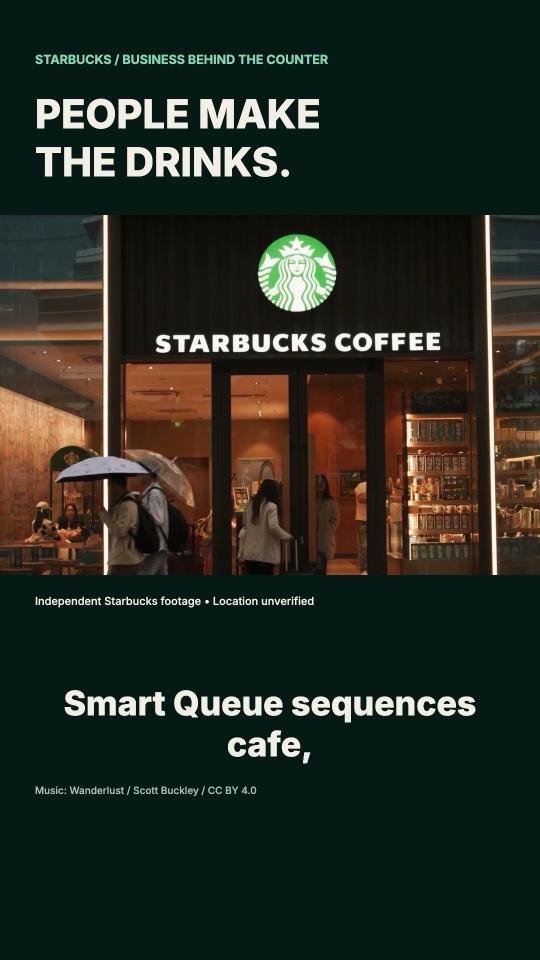
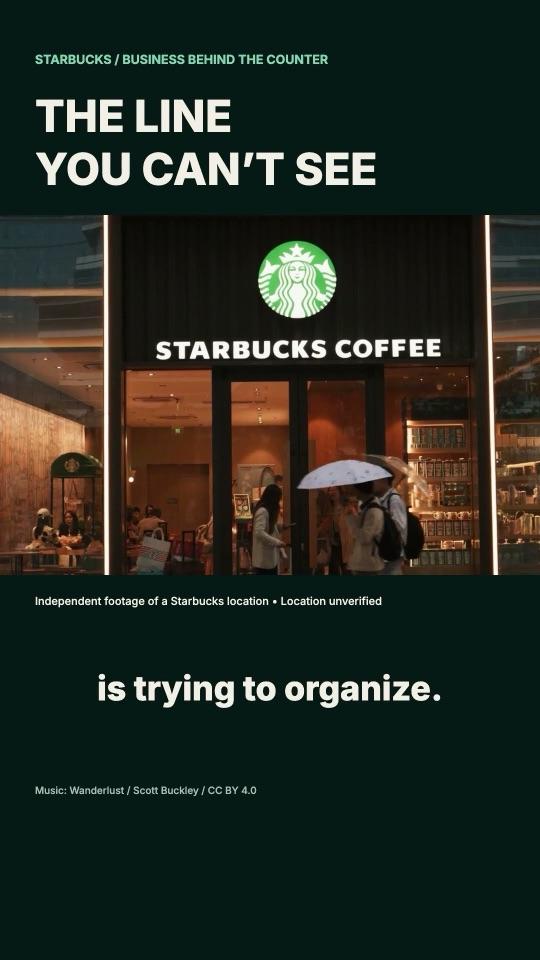
You walk into a coffee shop with one person ahead of you. Then a delivery rider arrives, a car pulls up outside and somebody on a phone orders six drinks. The line you can see has just become a terrible guide to how long your coffee will take.
Café, drive-thru, mobile and delivery orders can all feed the same coffeehouse. That is four ways to ask for a drink and one team turning those requests into actual cups. Starbucks calls its sequencing technology Smart Queue, and the interesting part is what sits beside it.
The $500 million staffing investment
In a September 2025 message to employees, CEO Brian Niccol said Starbucks had invested $500 million in additional employee hours through Green Apron Service, the operating model it was rolling out nationwide. The same message listed more hours, larger rosters and Smart Queue as parts of that one model.
That figure is a staffing investment. It is not an AI software budget, and it is not a verified AI saving. It matters because it points to a more awkward story than ordering coffee: how do you make a digital promise that the real world can actually keep?
One tap becomes real work
Start with that six-drink order. On a screen it arrives in one tap. Behind the bar it becomes several jobs: pull the espresso, steam the milk, build the cold drinks, finish the order. A small square on a phone can represent a surprising amount of work.
Arrival time is only part of the puzzle. The person at the counter is already waiting. The mobile customer may still be walking over. A delivery order has another journey after it leaves the store. Making everything immediately is not the same as handing everything over at the right moment. The same question sits behind DoorDash’s Instacart deal: software can take the request, but someone still has to do the physical work.
What Smart Queue does
At its January 2026 Investor Day, Starbucks described Smart Queue as a way to sequence café, mobile, drive-thru and delivery orders. Think of it as coordinating the work entering the bar. The algorithm still depends on the people, equipment and routines that turn a sequence into drinks.
In April 2026, Starbucks announced scheduled ordering, starting May 11 at North American coffeehouses with Mobile Order & Pay. Customers can choose an available five-minute pickup window up to an hour ahead. Starbucks says those windows reflect real-time availability at each coffeehouse and are powered by Smart Queue, and that availability may vary by location.
That pickup time is a promise about future capacity. It is easy to put a time on a screen. The hard part happens between the tap and the moment a barista sets the finished drink on the counter. A better sequence can organize the machine, the pitcher, the hand and the cup. It cannot make the steam wand do two jobs at once.
Green Dot Assist
Green Dot Assist does a different job. Starbucks introduced it in June 2025 as a generative AI assistant, piloted in 35 coffeehouses, that lets baristas ask questions on in-store iPads instead of flipping through manuals. Starbucks now describes it as support for questions about recipes, routines and service standards.
Smart Queue helps organize which work comes next. Green Dot Assist helps a person find information while doing the work. In both cases, the product is still made by the person at the bar.
What the evidence does and does not show
Put the pieces together and the staffing figure makes more sense. Starbucks was adding employee hours while adding tools around the employees. The useful question is whether the whole operation can absorb the demand an app makes so easy to create.
In April 2026, Starbucks reported that approximately 80% of its U.S. company-operated coffeehouses delivered café orders in four minutes or less. That is an encouraging snapshot, and it is company-reported. It describes café orders within a broader operating effort, with staffing and service changes alongside the technology. It cannot tell us what Smart Queue would achieve on its own.
For a business, that distinction matters. Better software, more staffing and clearer routines arrive as a package. If sales improve at the same time, the sales number alone cannot say which ingredient deserves the credit. And if the queue looks tidy while drinks sit waiting for pickup, the customer problem is still there.
The business takeaway
Go back to the person who saw one customer ahead of them. What they wanted was simple: a good drink, a reasonable wait and some confidence about when it would be ready. The work behind that experience is much less simple. Four streams of demand have to meet one physical operation.
That is the lesson I would take from Starbucks. Before making it easier for customers to ask, make sure the people delivering can keep the promise. The most useful technology may be the part you barely notice when your name is called.
Chapters
Each chapter opens the video on YouTube at that moment.
Sources
The sources cited in the video. The $500 million figure is additional employee hours, not an AI budget or a verified AI saving. Starbucks’ April 2026 post gives a broader figure, more than $500 million invested in partners since the Back to Starbucks plan began. Service results are company-reported.
- Message from Brian: Green Apron Service, one month in (Starbucks)September 8, 2025
- Starbucks is Back, Turning Momentum into Long-Term, Sustainable Growth (Starbucks Investor Day)January 29, 2026
- Meet Green Dot Assist: Starbucks Generative AI-Powered Coffeehouse Companion (Starbucks)June 10, 2025
- Making it easier to plan your Starbucks visit (Starbucks)April 22, 2026
- Supporting the moments that matter with artificial intelligence (Starbucks)January 29, 2026, updated June 2026
- Starbucks investments in coffeehouse partners are paying off (Starbucks)April 29, 2026
Watch the full documentary
5 min 9 sec on YouTube.
Written by Robert Hu; narration uses his authorized AI voice clone. Footage is independently licensed Pexels material by Orhan Pergel, Kampus Production, Los Muertos Crew, fauxels and Cheng Shi Song. Generic café staff are illustrative, not Starbucks employees or pilot locations, and the Starbucks exterior location is unverified. Graphics are original concept illustrations, not actual Starbucks software or order-priority rules. The opening six-drink scenario is illustrative. No official Starbucks press video is used. The 2014 drive-through photograph is by Christopher Tran, CC BY 2.0, cropped and animated. The thumbnail is an AI-assisted editorial composite using a real Starbucks cup photograph by Cadu Barral on Pexels as reference. Music: “Wanderlust” by Scott Buckley, CC BY 4.0. Espresso-machine sound: Ohrwurm on Freesound, CC0, used as editorial sound design, not location sound. Independent commentary; no Starbucks endorsement.