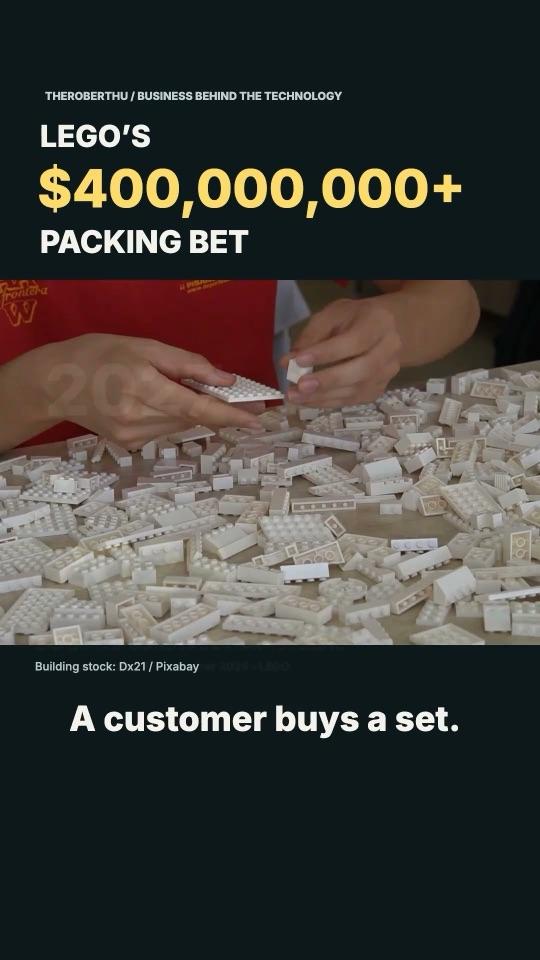
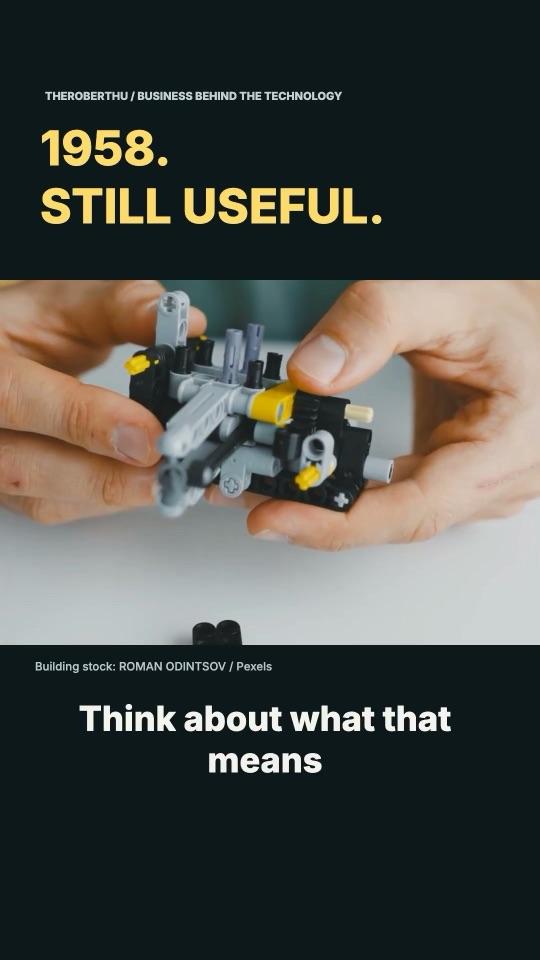
Watch the pieces come together. The clever part is what happens when you want to build something else: you can take them apart and the pieces still have a future.
That small idea sits inside a very big business. LEGO has announced more than US$400 million for an expansion in Monterrey, Mexico, and the new space is for packing and warehousing. Why does a toy company need that much more room behind the scenes? Follow a brick and the answer starts to appear.
Clutch power
LEGO has a name for the way its bricks hold together: clutch power. The studs are the part you notice, but turn a classic brick over and the underside matters too. Together, studs and tubes create the connection. Too loose and your masterpiece falls apart. Too tight and rebuilding becomes a wrestling match. The useful thing is the balance: your creation stays together and your next idea is still possible.
The 1958 design decision
On January 28, 1958, LEGO applied to patent its stud and tube design. Its history describes a practical problem. Earlier bricks were hollow, which reduced the stability of models and brought complaints from the market.
That decision had a remarkably long life. LEGO says bricks produced since 1958 are fully compatible with bricks made today. Think about what that means for a customer. A new set adds possibilities to a collection they already own. The old pieces still have a job, and the product can keep changing while a familiar connection stays useful.
Inside the factory handoff
Protecting a connection on a drawing is one thing. Repeating it in a factory is another. LEGO’s own archive footage shows the metal mold where an element takes shape, then a blue robot truck approaching a container station and bins moving across rollers. These scenes show molding and material movement, and they predate the newly announced expansion.
Making a piece starts a much longer journey. A pile of finished elements is still a long way from a complete set, and the handoffs matter for the same reason they do in Amazon’s robot warehouses.
Imagine opening a set on a rainy afternoon. You have the instructions, a growing pile of pieces and one small decision after another. The factory’s work has to disappear into that experience. Nobody opens a LEGO box hoping for a surprise lesson in warehouse management.
A beloved toy and a real business
Even a beloved toy can run into a real business problem. In 2004, the LEGO Group reported a net loss of DKK 1.931 billion, including discontinuing activities. Its annual report described a new direction, a tighter focus on the core business and substantial operational changes. A product people love still needs an operation and a business model that work.
By the first half of 2026, LEGO was reporting record revenue of DKK 41.9 billion, up 21% from a year earlier. That is revenue, not profit, and it is not directly comparable to the 2004 loss. LEGO points to demand across its range and to brand experiences, and says it is investing in factory capacity. A dependable brick connection is one part of a much bigger story, and growth brings another question: how do you get more complete sets into the markets that want them?
The $400 million packing bet
On September 24, 2026, LEGO set out plans to invest more than US$400 million in its Monterrey factory. The expansion includes a new packing hall and a fully automated high bay warehouse, adding 62,000 square meters of built-up area, and LEGO says it will raise the site’s production capacity by 35%, with about 1,300 new jobs through 2029. Construction is expected to start in early 2027 and finish by 2029, so these are plans, not results already delivered.
Here is why that detail matters. A customer buys a set, and hundreds or thousands of pieces may need to arrive together in the right assortment. LEGO describes boxes gliding under bins that release the exact amount of pieces, with packing operators folding the boxes, adding instructions and checking for mistakes. A newly molded element and a set ready for someone’s table are very different stages of the job. The finished product is the whole building experience.
The idea hiding inside the toy
For me, that is the business idea hiding inside the toy. You can keep offering people something new when the familiar parts remain useful and the operation can deliver the new thing reliably. The imagination can change with every box. The connection has to stay dependable.
The satisfying moment takes a second. Behind it are design choices, molding, material movement and the work of putting a complete set together. That is a lot of business hiding inside a little click.
Chapters
Each chapter opens the video on YouTube at that moment.
Sources
The sources cited in the video. The Monterrey figure is planned US-dollar investment, with construction expected from early 2027 to 2029. The 2004 net loss includes discontinuing activities. The H1 2026 figure is revenue, not profit, and is not directly comparable to that loss.
- The LEGO Group announces next phase of growth for Monterrey, Mexico manufacturing site (LEGO Group)September 24, 2026
- Strong demand and brand relevance drive LEGO Group revenue up 21%, operating profit up 22% in H1 2026 (LEGO Group)August 25, 2026
- The stud and tube principle (LEGO History)Checked November 6, 2026
- LEGO Group Company Profile (PDF)Checked November 6, 2026
- LEGO Group Annual Report 2004 (PDF)Fiscal 2004
- LEGO bricks in the making (LEGO Help Topics)Checked November 6, 2026
Watch the full documentary
4 min 59 sec on YouTube.
Written by Robert Hu; narration uses his authorized AI voice clone. Factory footage is ©2023 The LEGO Group, limited excerpts directly analyzed. The Monterrey archive photo is ©2026 The LEGO Group. Archive imagery does not show the newly announced expansion. Original diagrams are simplified illustrations, not engineering drawings or a live factory sequence. Building footage is by Dx21 on Pixabay and ROMAN ODINTSOV on Pexels, and the building still is by sofamuzaqi on Pexels. Stock illustrates building, not a test of vintage bricks. The thumbnail is an original AI-assisted illustration, not documentary evidence. Music: “Machina” and “Filaments” by Scott Buckley, CC BY 4.0, excerpted, mixed and faded. Original editorial sound cues. Independent editorial commentary; not sponsored by or affiliated with the LEGO Group.