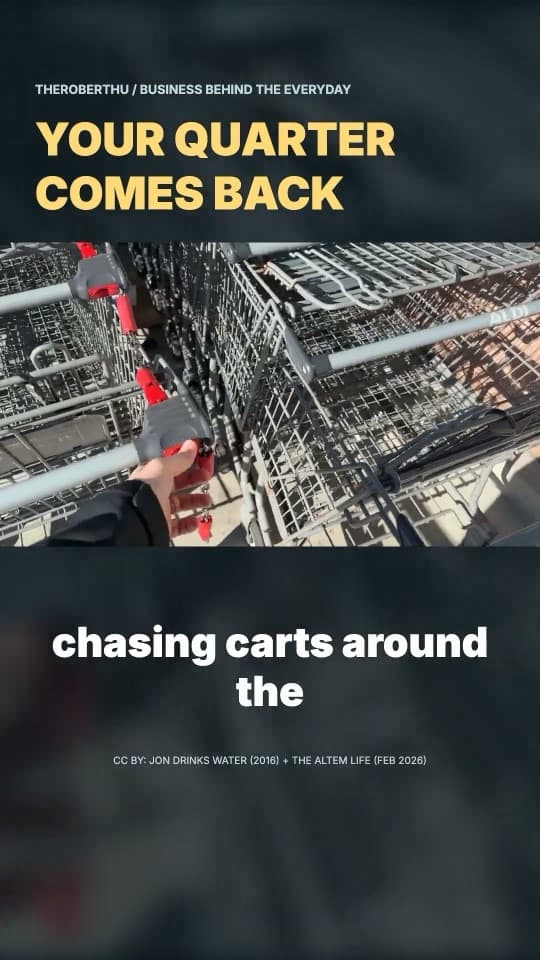
ALDI asks for a quarter before you get through the door, then gives it back. As a way to make 25 cents, it makes no sense. The quarter is there to make something else happen: you bring the cart back, and one small job gets done without a member of staff going out to collect it.
Look inside the store and the same idea shows up everywhere: the boxes, the bags, even the services that are missing. ALDI is asking a question most retailers would rather not put on the door. How much convenience would you give up for a cheaper shopping trip?
A $9 billion commitment
ALDI is putting serious money behind its answer. On January 12, 2026, it reaffirmed its commitment to invest $9 billion in the U.S. over five years through 2028, covering new stores, supply chain capacity and its online shopping experience. It plans more than 180 new stores in 2026 and has a goal of 3,200 stores by the end of 2028.
That figure is an investment commitment, not money already spent and not revenue from cart deposits. The quarter is a clue to the business ALDI wants to expand.
The cart changes the work
Insert the coin, release the cart, do the shopping. Return the cart, reconnect the chain, get the coin back. In ALDI’s words, with shoppers responsible for their carts, staff can focus on important tasks inside the store.
Nobody gets rich recovering a quarter, but the cart still ends up in the right place. There is a difference between making a task cheaper and designing things so the task happens differently. ALDI uses both.
The box is the display
Those cardboard cases on the shelf are not waiting for someone to finish the display. They are the display. ALDI’s history page lists everyday items displayed in their original shipping boxes to save on restocking shelves, and its supplier guidance asks for display-ready cases that can be merchandised with no repacking.
Instead of handling every package to build a perfect row, the outer container becomes part of the shelf. It is a small change in what the customer sees and a bigger one in what someone has to do repeatedly behind the scenes. Costco makes a similar trade with pallets on the sales floor. You do not eat the display. You eat what came in it.
The brand on the shelf
ALDI says more than 90% of the products in its stores are exclusive brands. That does not mean ALDI manufactures everything. It means much of the assortment is sold under its own labels rather than a wall of competing national brands, which gives the retailer more control over the product and its packaging. The box on the shelf and the product in the box can be designed together.
For the shopper, there is a trade. You may find an alternative to your usual brand rather than the exact thing you came for, and a lower price on something you do not want is not much of a bargain.
The work you take home
The trade gets more obvious at checkout. ALDI expects you to pack your own groceries, in bags you bring or buy there, and says self-bagging keeps lines moving and reduces costs. A store can sell you groceries and convenience. ALDI leaves some of that convenience for you to provide.
The businesses that are missing
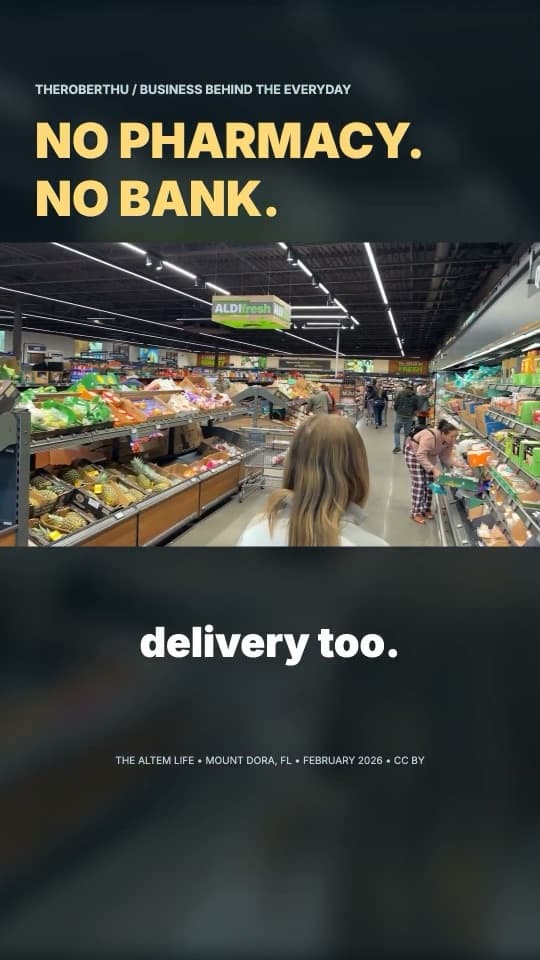
You cannot fill a prescription or do your banking here. ALDI’s description of its U.S. format explicitly leaves out add-on services like banks and pharmacies. That is a choice about what the store is trying to be. Every extra service needs space, equipment or people, and leaving one out makes the operation simpler. It can also mean another stop for someone who needs it. Saving money at one store is less exciting if the trip turns into a tour of three parking lots.
ALDI has not rejected convenience altogether. It offers curbside pickup and delivery, including through Instacart, DoorDash and Uber Eats, and its own guidance says online items may be priced higher to cover the cost of personal shopping or delivery. The work still has to happen. If you do not do it, someone else does, and the economics change.
The unexpected aisle
Then there is an aisle that seems to have wandered in from another shopping trip. In the February 2026 store tour used in the video, there is a pet sofa, and a few steps away, a kit for building a little ALDI store. ALDI Finds is its rotating selection of limited-time items, and as ALDI puts it, it is not always food.
The efficient store still has room for a surprise. Whether that surprise belongs in your budget is a different question.
The deal behind the groceries
The more interesting business question is whether shoppers like the whole arrangement enough to keep coming back. That is what makes the $9 billion commitment worth watching: it is a plan to repeat the system in more places while expanding the supply chain and digital shopping around it. The carts do not pay for that. They show the operating model in miniature.
The quarter, the cardboard and the bagging counter are parts of the same decision: what the retailer does, what the shopper does, and which extras neither of them has to pay for. The real transaction was never the 25 cents. It was the deal you accepted to go shopping.
Chapters
Each chapter opens the video on YouTube at that moment.
Sources
The sources cited in the video, plus three ALDI pages added here for the cart, shipping box and self-bagging details. The $9 billion figure is a five-year investment commitment through 2028. ALDI’s product page says more than 90% of products are exclusive brands; its March 2026 store announcement says nearly 90%. No cheapest-basket or shopper-savings claim is made, and prices visible in the store footage are not current offers.
- ALDI 101: format and refundable cart deposit (ALDI US)Checked November 3, 2026
- ALDI US Doubles Down on Growth in 2026 (ALDI US newsroom)January 12, 2026
- Product Safety and Quality (ALDI US)Checked November 3, 2026
- In-Store Pricing vs. Online Pricing (ALDI Support)Checked November 3, 2026
- ALDI, America’s Fastest-Growing Grocer, Expands to Portland Opening First Store in Maine (ALDI US newsroom)March 2, 2026. Added on this page; not cited in the video.
- ALDI History (ALDI US)Checked November 3, 2026. Added on this page; not cited in the video.
- Supplier FAQs: Display Ready Case (ALDI US)Checked November 3, 2026. Added on this page; not cited in the video.
Watch the full documentary
5 min 15 sec on YouTube.
Written by Robert Hu; narration uses his authorized AI voice clone. Store-tour footage is from “Is Aldi the Place for Cheap Groceries?” by the altem life, filmed in February 2026 in Mount Dora, Florida. Cart-mechanism footage is archival, from “Jon Drinks Water #3771 Aldi Shopping Carts” by Jon Drinks Water, published in 2016. Both carry Creative Commons Attribution licences and were excerpted, reframed and muted, with original narration, captions and graphics added. Prices in the footage are not current offers. The thumbnail is a designed editorial illustration. Music: “Machina” and “Filaments” by Scott Buckley, CC BY 4.0. Coin sound: “Coins #1” by Joseph Sardin / BigSoundBank, CC0, used as editorial Foley. No endorsement by ALDI or the source creators is implied.