The candy bowl is supposed to be the easy part of Halloween. This year it hides a puzzle. The World Bank’s cocoa benchmark averaged about 20% less in the third quarter of 2026 than a year earlier. Meanwhile, U.S. candy and chewing gum prices in September were about 7.7% higher than the previous September, according to the Bureau of Labor Statistics.
Those are different measures covering different things, and neither reveals what any manufacturer actually paid for cocoa. Together they raise a reasonable shopper’s question: where did the saving go?
Hershey’s sales-volume split
Hershey offers a way inside the problem. Its North America Confectionery segment recorded $2.17 billion in net sales in the second quarter of 2026, up 4.2%. That is one segment, not Halloween revenue and not profit. The twist is underneath: price realization rose about 14% while volume fell about 10%. Sales went up while less product went out.
The price has a memory
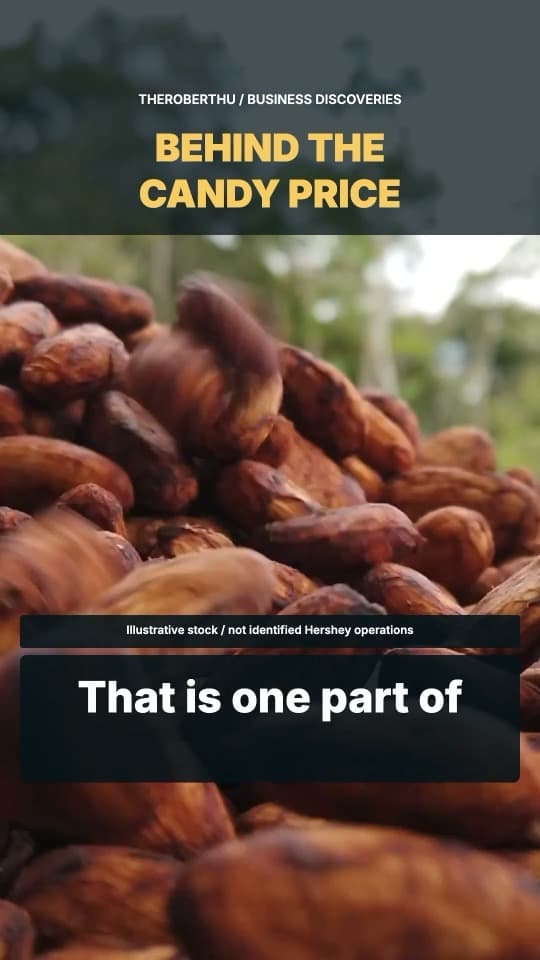
A cocoa bean travels through growing, processing, manufacturing and distribution before it becomes a chocolate cup. A market quotation measures one part of that journey. It does not measure the finished bag, its packaging, the energy used to make it or the work of getting it onto a shelf.
Then there is timing. Hershey says it generally hedges commodity price risks for 3- to 24-month periods, and that as a result, average market prices are not necessarily indicative of its average costs. Think of booking a flight and watching the fare drop afterward. The cheaper seat is real, but it does not rewrite the ticket you already bought.
Buying ahead gives a manufacturer more certainty when prices rise and limits how quickly it benefits when they fall. That is a trade-off, not proof that every bag contains expensive old cocoa. A falling commodity chart cannot, by itself, tell us what a manufacturer paid, what a supermarket paid or what a shopper should be charged tomorrow.
The customer gets a vote
A cost explanation is not a complete explanation of price. Competitors, retailers and shoppers all have a say. Hershey attributed its second-quarter volume decline in North America Confectionery primarily to price elasticity: people reacting to higher prices by buying less.
Shoppers do not need a spreadsheet to respond. They pick a smaller bag, a different brand, something fruity instead of chocolate, or simply less candy. Higher sales help the financial result. Fewer purchases make the next sale harder to win.
The pattern held after the video’s main figures. In its third-quarter results on October 29, Hershey reported North America Confectionery net sales up 1.6%, with about 13 points of price realization and volume down about 11 points, which it attributed to price elasticity and normal quarter-to-quarter shipment variability.
Halloween before October
Hershey’s answer is to make Halloween bigger than October 31. In a company-commissioned survey with Morning Consult, released in July, 67% of parents said they had already bought Halloween candy that summer. That is self-reported behavior, not a count of Hershey sales, but it explains why a candy company wants the Halloween conversation to start while people are still on summer vacation.
For 2026, Hershey announced more than 20 seasonal product innovations across chocolate, sweets and salty snacks. Reese’s Pumpkins returned, and fruity and sour options joined assorted bags. The idea is to serve different tastes and occasions, from an early treat to a party, a shared bowl and trick-or-treat night, instead of asking one chocolate product to do every job. Product announcements are not sales results.
More occasions, not just more customers
The household wants enough candy for the people who actually show up. The company wants enough reasons for households to buy before that night arrives. One bowl, two planning problems. Buy too late and the favorite may be gone. Buy early and someone at home may help the inventory disappear.
Who has to say yes?
Cheaper cocoa can help a manufacturer. It does not act like a refund button at checkout. Past purchasing decisions, other costs, retail decisions and what customers will accept all sit between the bean and the bag, and Hershey’s own volume decline shows shoppers are part of that calculation. The price contains timing, and the next sale depends on giving someone a reason to choose it again. The same holiday runs on a different deadline for Spirit Halloween’s temporary stores.
What changed in your candy bowl this year?
Chapters
Each chapter opens the video on YouTube at that moment.
Sources
The sources cited in the video, plus Hershey’s third-quarter release. The cocoa and candy comparisons use different measures and periods, and neither reveals Hershey’s actual ingredient costs. Segment figures are net sales, not profit or Halloween revenue. Price realization and volume are company segment measures, not changes to every store ticket. The July survey is self-reported and company-commissioned.
- Commodity Markets: monthly prices (World Bank Pink Sheet)Q3 2025 and Q3 2026 cocoa averages
- Consumer Price Index: candy and chewing gum, U.S. city average (BLS series CUUR0000SEFR02)September 2025 and September 2026
- The Hershey Company Form 10-Q, quarter ended June 28, 2026 (SEC)Q2 2026
- The Hershey Company 2025 Form 10-K, in the 2026 annual report (PDF)Fiscal year 2025
- Anticipation Is Reshaping America’s Halloween Season (Hershey)July 29, 2026
- The Hershey Company Unwraps Its 2026 Halloween Portfolio (Hershey)August 13, 2026
- Hershey Reports Third-Quarter 2026 Financial Results (SEC, exhibit 99.1)October 29, 2026. Added on this page; not cited in the video.
Watch the full documentary
5 min 35 sec on YouTube.
Written by Robert Hu; narration uses his authorized AI voice clone. Chocolate and shopping scenes are illustrative Pexels stock, not identified Hershey facilities or customers. Product photographs by Evan-Amos (Wikimedia Commons, public domain) are archive images from 2010 and 2011, not 2026 campaign footage. Cocoa-drying photograph by Chuck Moravec (CC BY 2.0), cropped and animated. The cover artwork is illustrative, not a photograph of an actual event. Independent editorial production; no brand endorsement. Music and sound credits are listed in the YouTube description.