A robotic arm lifts a parcel, turns and feeds the next part of the line. One task, done. But what if the next step is not ready?
Amazon says it has deployed more than a million robots across more than 300 facilities. At that scale, even waiting becomes a business problem, and the answer is not always another robot.
The $775 million Kiva agreement
In March 2012, Amazon agreed to acquire Kiva Systems for approximately $775 million in cash. Amazon described Kiva’s technology as a way to bring products directly to employees to pick, pack and stow. Instead of sending a person walking through the warehouse to find a product, the shelf comes to the person.
That changes the shape of the problem. The worker stays at a station and the inventory travels. A job that used to be about walking becomes a problem of movement, timing and software.
Warehouse rush hour
Then scale it up. Hundreds of robots want to arrive at stations while others need to leave, all sharing the same space, intersections and destinations. Automating the walking does not abolish rush hour.
In 2022, Amazon’s robotics researchers described the catch. At first, adding robots increases throughput. At a certain point, their numbers start to cause congestion: the robots interfere with each other and reduce the efficiency of the whole system. The shortest route for one machine can be a terrible route for everybody else.
DeepFleet and the traffic problem
That is the business problem behind DeepFleet, the generative AI foundation model Amazon introduced in June 2025 alongside the news that its millionth robot had reached a fulfillment center in Japan. DeepFleet learns from robot movement data to predict how traffic is likely to unfold, and Amazon’s scientists say those predictions can help assign tasks to robots and route them around potential congestion.
Picture two routes to the same station. One is shorter, but everybody wants it. The other takes a little longer but keeps moving. The clever decision can be choosing the second route before the first one backs up. What matters is what gets through the building, not which machine wins the race to the intersection.
What the 10% claim actually means
Amazon put a number on the opportunity: a 10% improvement in robot fleet travel efficiency. That is Amazon’s claim, and it describes how the robots travel. It is not a 10% saving on everything Amazon spends delivering an order. Still, less wasted travel means more useful movement from equipment and floor space the company has already invested in.
Follow the real handoffs
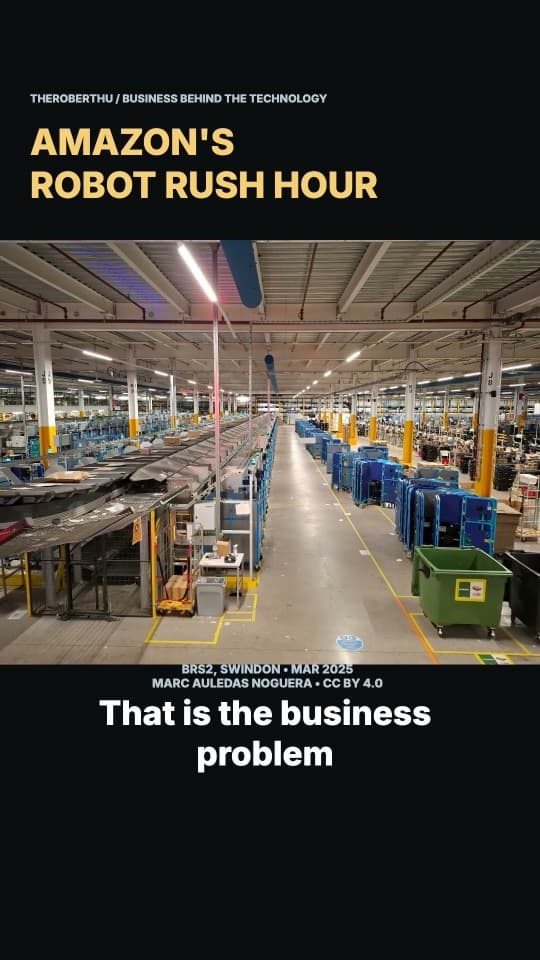
The footage in the video was filmed at Amazon’s BRS2 fulfillment center in Swindon, UK, in March 2025. It shows different stations, not one customer’s order followed from start to finish: a robotic arm placing a package onto the line, a measuring gate where parcels pass through sensors, and a station that applies shipping labels to moving boxes.
Each successful handoff raises a new question: is the next stage ready for what is arriving? If the robot can feed boxes faster than the next station can process them, speeding up the robot again just builds a longer queue. An impressive demonstration is the beginning of the business case, not the end of it. The same lesson runs through FedEx’s overnight network, where fast sorting only matters if the rest of the chain keeps up.
The cost around the machine
The $775 million Kiva figure was an acquisition price, not the total cost of Amazon’s robotics program. Machines, maintenance, software, training and the rest of the operation around them all have to be paid for. A faster piece of equipment does not automatically lower the cost of a completed order. The gain has to survive the next handoff, and the one after that.
People and the ordinary shift
There are people in this system. Bringing a shelf to a worker can reduce walking, but on its own it does not answer questions about pace, repetitive work or safety. In December 2024, the U.S. Department of Labor announced a corporate-wide settlement with Amazon requiring ergonomic measures at covered facilities, including fulfillment centers, sortation centers and delivery stations. Amazon, for its part, reports that its recordable incident rate improved 34% over five years.
A robot count is not a safety score. For anyone evaluating automation, the useful question is what happens across an ordinary shift, including the interruptions.
The real test is consistency
Once a delivery experience works well, it becomes the expectation. Customers never see the warehouse choreography. They see whether the promise was kept. The million-robot milestone gets the headline. The less visible challenge is getting the machines, the software and the people to work as one system, again and again.
Next time you see an impressive robot demo, look just beyond it. What is waiting on the other side?
Chapters
Each chapter opens the video on YouTube at that moment.
Sources
The sources cited in the video. The $775 million Kiva figure is the 2012 acquisition agreement, not Amazon’s total robotics spend. The 10% figure is Amazon’s claim for robot fleet travel efficiency, not a saving on total delivery costs. Injury rate improvements are Amazon’s own reported figures.
- Amazon.com to Acquire Kiva Systems, Inc. (Amazon press release)March 19, 2012
- Amazon launches a new AI foundation model to power its robotic fleet and deploys its 1 millionth robot (About Amazon)June 30, 2025
- How Amazon robots navigate congestion (Amazon Science)May 24, 2022
- Amazon builds first foundation model for multirobot coordination (Amazon Science)August 11, 2025
- US Department of Labor announces settlement with Amazon requiring corporate-wide ergonomic measures (U.S. Department of Labor)December 19, 2024
- Amazon’s 2024 workplace safety performance shows annual improvement (About Amazon)March 13, 2025
Watch the full documentary
5 min 7 sec on YouTube.
Written by Robert Hu; narration uses his authorized AI voice clone. Warehouse footage and photographs are by Marc Auledas Noguera (Auledas) on Wikimedia Commons, CC BY 4.0, filmed at Amazon’s BRS2 fulfillment center in Swindon, UK, in March 2025, then edited and reframed with source audio removed. Different stations are shown, not one order tracked end to end. Traffic, shelf and queue animations are original illustrations, not Amazon operational data. The thumbnail is an AI-assisted editorial illustration based on the credited warehouse photograph. Music: “Machina” and “Filaments” by Scott Buckley, CC BY 4.0. Independent commentary; no Amazon endorsement.