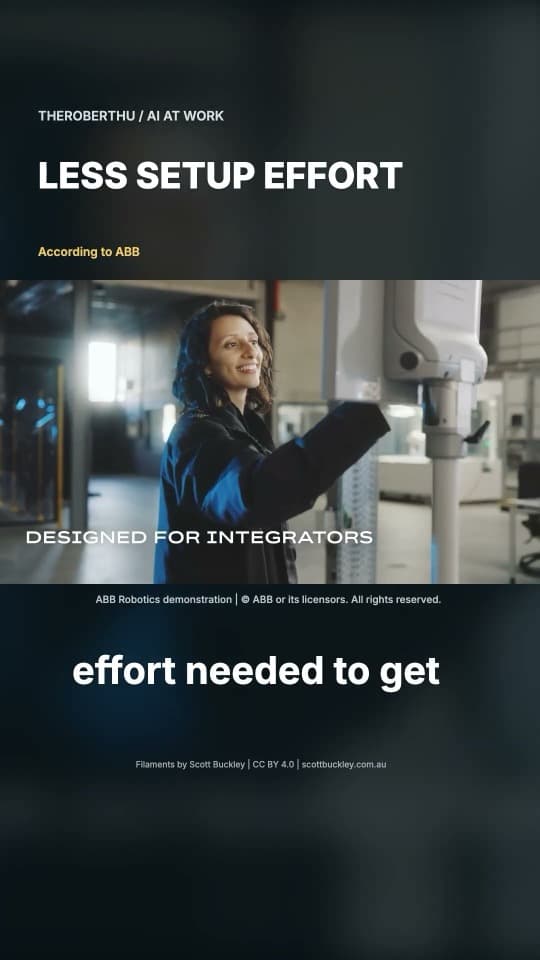
A robot lifts a bag of clothes. A small movement, and a very big business bet. SoftBank agreed to pay $5.375 billion for ABB’s robotics division. If AI is about to make robots more valuable, why would ABB sell?
SoftBank wants a foothold in the physical world. ABB already has one and is choosing where to put its next dollar. The agreement was announced in October 2025. In its third-quarter report on October 20, 2026, ABB still expected completion in the fourth quarter of 2026, so the deal remains pending.
What the money buys
The division generated $2.3 billion in revenue in 2024, about 7% of ABB Group revenues, with a workforce of approximately 7,000. It comes with factories, engineering expertise and existing customers. One is a Shanghai factory that opened in 2022 after a $150 million investment, where mobile robots move materials and robotic systems handle tasks such as screwdriving and assembly. Another is Auburn Hills, Michigan, ABB Robotics’ refitted U.S. headquarters and manufacturing facility.
Those details matter. An AI company entering industry has to get its technology into a customer’s operation. Someone has to install the equipment, train the people and keep the system useful. SoftBank is buying a business that already does that work.
The cost of adapting robots
A rigid part sitting in the same position is one problem. Apparel in changing bags, orientations and packaging is another. The machine has to work out what it sees and how to handle it, and then the products change again. The business case turns on two questions: how much work does it take to get a robot ready, and how much more will the next change require?
ABB’s AI Robot Trainer
In October 2026, ABB added AI Robot Trainer to its Fashion Inductor application. Operators work with training images, monitor performance and retrain the system as requirements change. ABB says the approach can reduce engineering and commissioning effort, the work of getting a system ready to run, by up to 75% in that fashion logistics application.
That is a manufacturer’s claim about one application. It is not a 75% cut in a customer’s total costs, and it does not say when the investment pays back. For a buyer, the questions are practical: how much setup time is actually saved, how often a person intervenes and what happens when new packaging arrives. The same claim comes up in the documentary on why AI that works does not always make a business more money.
NVIDIA and simulation
ABB is also integrating NVIDIA simulation technology into RobotStudio HyperReality, announced in March 2026. Engineers can build virtual workcells and generate training data before deploying to physical equipment, testing more situations before asking a real machine to do the job.
Lighting, surfaces, materials and movement all have to translate into the actual workspace, and a virtual success still needs validation on the floor. For a manufacturer, the useful result would be less disruption while bringing a process online.
Why ABB would sell
ABB says there are limited business and technology synergies between robotics and the rest of the company, which have different demand and market characteristics. It had already planned to spin the division off as a separately listed company before SoftBank’s offer replaced that plan. Selling a promising division can still make sense if the money and management attention have better uses elsewhere.
ABB’s AI exposure continues through the infrastructure that powers data centers. In September 2026, it introduced Infinitus, a direct current power portfolio for AI data centers, with some of the equipment still to come to market. In its October 20 results, ABB reported a triple-digit increase in data center orders. ABB can pursue AI spending through power infrastructure while SoftBank pursues machines that perform work.
What SoftBank needs to prove
For SoftBank, the attraction is the combination of AI investment, industrial equipment and a route into customers’ operations. The hard part is making that combination earn more than the pieces would separately. A better model has to survive real product changes, a useful robot has to be supportable, and an easier installation has to produce enough value for the customer to order the next one.
If AI cuts the work needed to deploy and adapt these machines, the opportunity could extend across more applications. If that work stays expensive, the ambition runs into the same operational limits.
Beyond the demo
So watch what happens after the demonstration: repeat orders, reliable operation and the cost of adapting to change. That is where a $5 billion bet becomes a business.
Would you rather own the robots doing the work or the power infrastructure behind AI?
Chapters
Each chapter opens the video on YouTube at that moment.
Sources
The sources cited in the video. The $5.375 billion is the agreed enterprise value, rounded to $5.4 billion in the title, and the deal had not closed as of ABB’s October 20, 2026 report. The up to 75% figure is ABB’s claim for one application, not a verified reduction in customer costs or a proven payback.
- ABB to divest Robotics division to SoftBank Group (ABB)October 8, 2025
- Acquisition of ABB Ltd’s Robotics Business (SoftBank Group)October 8, 2025
- ABB Q3 2026 results (ABB, PDF)October 20, 2026
- ABB opens state-of-the-art robotics mega factory in Shanghai (ABB)December 2, 2022. The link in the YouTube description no longer loads; this is the same release on ABB’s current site.
- ABB opens refitted, state-of-the-art US robotics facility (ABB)March 13, 2024
- ABB Robotics brings industrial-grade physical AI to fashion logisticsOctober 15, 2026
- ABB Robotics partners with NVIDIA to deliver industrial-grade physical AI at scaleMarch 9, 2026
- ABB’s new direct current portfolio aims to rewire AI data center energy infrastructureSeptember 21, 2026
Watch the full documentary
5 min 7 sec on YouTube.
Written by Robert Hu; narration uses his authorized AI voice clone. ABB Robotics footage © ABB or its licensors, used in independent editorial reporting under ABB’s published editorial exception; archive, manufacturer demonstrations, simulation and the Infinitus concept illustration are labeled on screen. Mechanical sound effects are added sound design, not recordings of the machines shown. The map uses public-domain Natural Earth boundaries. The thumbnail is an AI-assisted illustrative cover based on the opening apparel-handling demonstration, not a photograph of an acquisition event. Company logos identify the subjects of this independent report; no sponsorship or endorsement implied. Music credits are listed in the YouTube description.