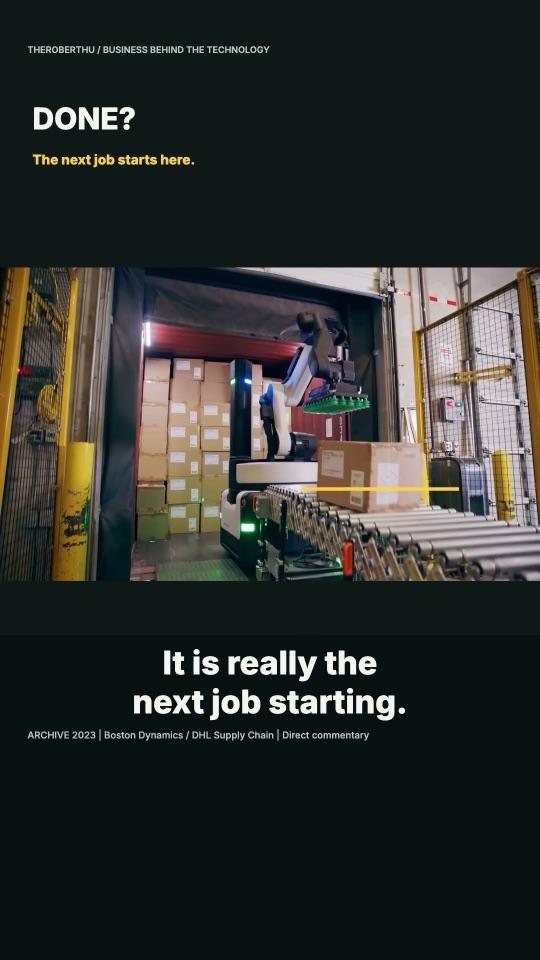
Watch a box leave a trailer. The robot grips it, lifts it and sends it onto a conveyor. It is a neat little victory for automation, and getting the box out of the trailer is only the first problem. The rest of the building still has work to do.
That is what makes DHL’s robot story more interesting than an arm that can lift things.
A $15 million, multi-year program
In January 2022, DHL Supply Chain announced a $15 million investment in robotics from Boston Dynamics: a multi-year agreement beginning with Stretch, in what the companies called the first commercial purchase of the robot. That figure covered a program. There was no $15 million price tag on one machine, and the announcement did not say how many robots the money would buy.
A wonderfully unglamorous job
The first task was truck unloading. Imagine your shift starts with a wall of cartons. High ones, low ones, another row behind them. Every one has to come out before the trailer is empty. Do that once and it is a lift. Do it through a shift and it becomes a very different job. Stretch was built to take on that repetitive handling.
The gripper and the handoff
In Boston Dynamics’ film from January 2023, look at the business end of the arm. Suction cups form the gripper. The system takes one box at a time and places it on the conveyor. From there, the film explains, the carton travels through scan tunnels and into DHL’s system.
Pause on that handoff. The robot has finished its movement. The warehouse has only started processing the box.
When the next step cannot keep up
Now imagine the first step gets faster while the next step stays the same. Cartons pile up between them. The arm is having a great day. Your delivery schedule might disagree.
That is an illustrative scenario, not evidence of a failure at any DHL site. It is why an impressive pick rate is only the opening question. How much useful work gets all the way through? The same question follows Amazon when it has a million robots to direct.
Up to 700 cases per hour
In May 2025, DHL reported case unloading rates of up to 700 cases per hour. Up to is doing real work in that sentence. It is a reported result, not a promise that every trailer will run at that speed. The same announcement described end-to-end automation combining conveyors and palletizers in a UK project. The arm was becoming part of a longer process.
The people around the machine
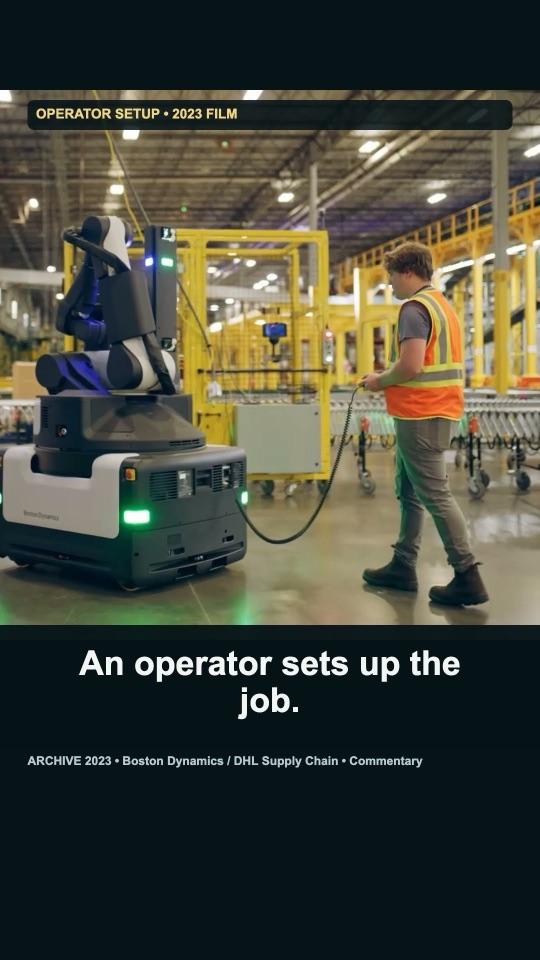
There is a human story here too. In the film, an operator positions the machine, and employees describe heavy boxes and hot or cold trailers. The attraction is easy to understand: let the machine repeat the lifting while people operate and support the process. Those accounts come from a company case study. They do not tell us what happened to every job across DHL.
The software between the machines
Then comes the less photogenic part of the story: getting different technologies to work together. In March 2026, DHL Supply Chain described SVT Robotics’ SOFTBOT integration platform as live at 30 sites, with more than 100 planned over the next three years. That is a separate software rollout, not a count of Stretch installations.
One useful machine is a start. Making it work in the next building, with that building’s systems and routines, is another job.
The wider automation budget
The money behind that wider effort is substantial. In May 2025, DHL said it had invested more than €1 billion over the past three years in automation in its contract logistics division. That is a broad budget, and not all of it went to this robot.
The same announcement was a memorandum of understanding that, in the companies’ words, “paves the way” for more than 1,000 additional units. A plan is different from a completed fleet. None of these figures gives the payback period for one installation. For that, we would need its full costs and operating results. They do show the size of the ambition.
Back to our box
Go back to the box. The interesting moment is when it leaves the robot and joins everything else.
My takeaway is this: buy a better flow of work, not just a faster movement. The arm gets the attention. The handoff decides what that movement is worth.
Chapters
Each chapter opens the video on YouTube at that moment.
Sources
The sources cited in the video, plus published copies of two DHL announcements. The case study and film are company accounts, not independent tests. The $15 million, the €1 billion and the site counts measure different things, and none gives the payback of an installation.
- DHL Supply Chain to invest $15 million to further automate warehousing in North America via Boston Dynamics collaboration (Boston Dynamics)January 26, 2022
- DHL Group signs MoU with Boston Dynamics and accelerates cross-business automation strategy (DHL Group)May 13, 2025
- DHL Group Signs MOU for 1,000-Robot Deployment (Boston Dynamics)May 13, 2025
- Stretch at DHL (Boston Dynamics case study)Checked November 9, 2026
- Stretch at DHL: Automated Trailer Unloading (Boston Dynamics film)January 31, 2023
- DHL Supply Chain accelerates automation deployments with SVT Robotics SOFTBOT platform (DHL Group, PDF)March 2026
- DHL Supply Chain accelerates automation deployments with SVT Robotics SOFTBOT platform (Robotics 24/7)March 30, 2026
Watch the full documentary
4 min 7 sec on YouTube.
Written by Robert Hu; narration uses his authorized AI voice clone. Brief, muted excerpts and frame grabs from Boston Dynamics’ official January 2023 Stretch at DHL film are used only for direct analysis of the gripper, conveyor handoff and operator setup; © Boston Dynamics / DHL Supply Chain. This is archive company footage, not an independent test. Illustrative warehouse, manual-handling and parcel footage is by Tiger Lily, Tima Miroshnichenko and Erkan Avanoğlu on Pexels; these stock scenes are not DHL sites. Original diagrams are hypothetical and do not depict a measured DHL bottleneck or incident. Music: “Cylinder Eight” by Chris Zabriskie, from Cylinders, CC BY 4.0, edited and mixed. The thumbnail is an original conceptual AI illustration. Independent commentary; no endorsement implied.