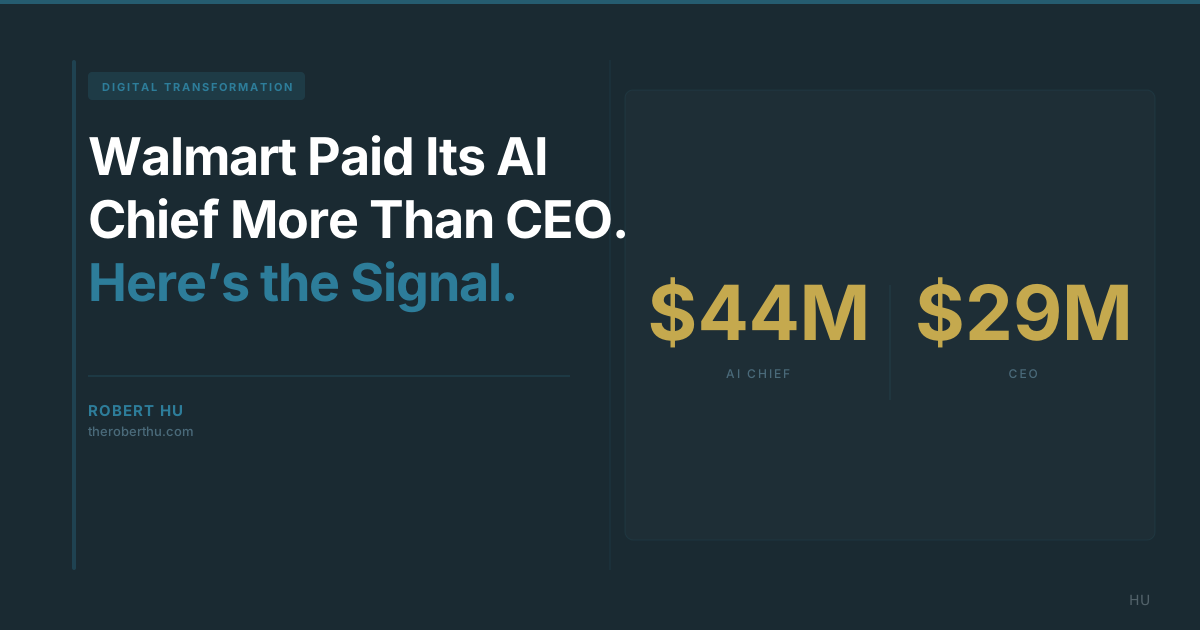
Walmart paid Daniel Danker, its EVP of AI acceleration, $44.1 million in 2025. That's more than CEO Doug McMillon's $29.2 million. The sign-on bonus alone was $5 million.
This isn't a quirky line item in a proxy filing. It's Walmart publicly declaring where the next decade of retail will be won or lost. For brands doing $100K to $2M selling on Walmart, the signal is clear. The AI layer is now the core of Walmart's strategy, and your marketplace playbook needs to reflect that.
Key Takeaways
- $44.1 million total comp for Walmart's AI chief vs $29.2 million for CEO Doug McMillon. The largest signal yet that Walmart sees AI as its competitive moat.
- $5 million sign-on bonus for Danker, roughly 17% of the CEO's entire annual package. Walmart paid a premium to secure AI leadership.
- Sparky recommendations are now the primary discovery channel on Walmart, not keyword search or ad spend. The compensation confirms where the investment is going.
- AI-ready listings beat ad budgets in this environment. The sellers whose listings Sparky recommends will outperform the ones still optimizing for 2022-era Walmart search.
What Is Walmart Actually Signaling?
Executive compensation is the clearest signal a company sends about where it believes value is created. When a company pays a functional leader more than the CEO, it's telling shareholders, competitors, and the market exactly one thing: this is where our moat is being built.
Walmart has plenty of places it could be spending that money. Store automation. Fulfillment infrastructure. Merchandising technology. The company's $25 billion capital spending program touches all of those. But the person being paid the most isn't running any of them. The person being paid the most is the one building the AI systems that decide what gets recommended, what gets found, and what gets purchased.
Robert Hu has been saying this for months: the leadership transitions at Walmart are accelerating an AI-first strategy, not just continuing the status quo. Danker's comp is the financial confirmation of that strategic shift.
Newsletter
Follow the research
Research notes and analysis on how AI, digital transformation, product discovery, and customer behavior are changing commerce.
Subscribe to Hu's Weekly HootHow Should Walmart Sellers Read This?
If you're selling on Walmart Marketplace, this compensation story translates directly into a strategic mandate for your 2026 and 2027 listings. The company is building its moat around AI. Your growth on the platform will be determined by how well you show up inside that AI layer.
Three things this means in practice:
1. Sparky recommendations will be the primary discovery channel. Not keyword search. Not Walmart Connect ads alone. Not traditional organic ranking. Sparky is being integrated into ChatGPT and Gemini, and Walmart is paying top-of-market rates to keep that infrastructure evolving. The sellers who optimize for Sparky will capture a disproportionate share of purchase intent.
2. Ad budgets matter less relative to data quality. You can outbid your competitors on Walmart Connect and still lose to a better-optimized listing if Sparky won't recommend you. This doesn't make ads useless. It makes data quality the prerequisite for ads to work.
3. The platform is going to evolve fast. Danker's job is to accelerate Walmart's AI systems. His team will ship updates to Sparky, expand ad formats inside AI conversations, extend integrations to new surfaces (Gemini, ChatGPT, agentic shopping). Listings that were "good enough" in 2024 will fall behind. Listings optimized for AI readability will compound their advantage with each platform update.
What Should You Do About It?
Adjust your Walmart strategy this quarter. Not next year. Not after your next ad review. Now.
Audit your top 10 Walmart listings for AI readiness. Do they answer who the product is for, when and where to use it, and why it solves a specific problem? Can Sparky match your listing against a conversational query like "best [product] for [specific situation]"? If you can't answer yes confidently for each SKU, that's your first fix.
Complete every backend attribute field. Material, size, age range, compatibility, dietary info, certifications. These structured fields feed both Walmart search and Sparky. Empty fields mean missed recommendations. Sparky users spend 35% more per order, so missing these recommendations compounds into real lost revenue.
Shift your A+ content from generic lifestyle to specific use cases. Sparky reads A+ text. Generic imagery gives Sparky nothing to work with. Use-case scenarios with explicit context help Sparky match your product to the shopper's stated need.
Watch Walmart search analytics weekly. The keyword-level data Walmart now provides is a direct window into how Sparky evaluates your listing. High impressions with low clicks is the fastest diagnostic for AI readiness gaps you can fix.
Treat digital transformation as an ongoing discipline, not a project. Danker's team will keep shipping updates. Your competitors who get on the treadmill earliest will be hardest to catch.
The Bottom Line
When a company pays its AI chief $15 million more than its CEO, you pay attention. When that company is the second-largest retailer in the world, you adjust your strategy. Walmart's compensation disclosure is not a quirky HR story. It's the clearest preview yet of where marketplace success will be decided over the next 24 months.
The sellers who thrive on Walmart in 2026 and 2027 will not be the ones with the biggest ad budgets or the oldest relationships. They will be the ones whose listings Sparky recommends because the data quality is there.