Fast Company published a long-form feature on May 7 with the commerce leads at Google and OpenAI. The headline finding: agentic commerce is months away from a tipping point, not years. OpenAI's commerce lead Ajjarapu told the publication, "Every couple months, we just see such massive changes to what our models are able to do. It is impossible for me to predict what's going to happen on what timeline." Forrester analyst Emily Pfeiffer was blunter: "Nobody has figured it out, but everyone has FOMO. Everyone is prematurely rushing to market."
If the tipping point is months away, what should a $500K to $5M brand actually do between now and then? The answer is not "wait and see." The answer is also not "panic and pivot." It is "do the data work that will compound through the transition, regardless of which platform wins."
That distinction matters because the broader Agentic Engine Optimization layer rests on data quality decisions you make in the next 90 days. The brands that ship those decisions in Q2 will be ready when the agentic surfaces go mainstream. The brands waiting for clarity from Google or OpenAI will be optimizing during peak traffic instead of arriving with the foundation in place.
What does "months away" actually mean for marketplace sellers?
The tipping point is the shift from "AI agents recommend products" to "AI agents complete transactions on the buyer's behalf with reliable conversion." The first state is already here. Rufus, Sparky, Perplexity Shopping, ChatGPT recommendations, Gemini answers all surface products to buyers today. The second state is what Google and OpenAI are racing to build, and the gap between the two is what the Fast Company executives describe as "months, not years."
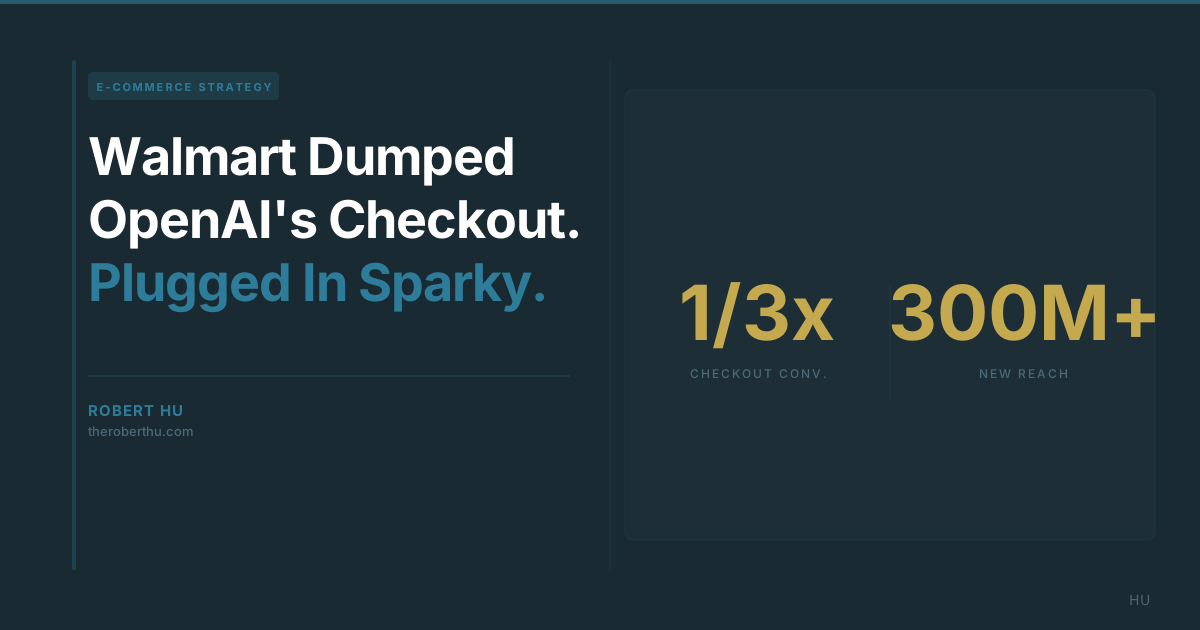
The technology gap is not the model. It is the integration layer. The Fast Company piece confirms what Walmart's Instant Checkout failure already showed: LLMs were not built for commerce. Every retailer has different rules. Every product has different attributes. Every checkout flow has different validation. Standardizing the protocol is the bottleneck, which is why Amazon joined the Universal Commerce Protocol in April after eight months of fighting it.
McKinsey projects up to $1 trillion in US AI-driven commerce revenue by 2030 and up to $5 trillion globally. Even if the tipping point is months instead of weeks, the economic stakes are large enough that every major platform is building toward the same future. Meta is building Hatch and an Instagram shopping agent. OpenAI is layering agentic flows on top of ChatGPT. Google is building agentic commerce inside Gemini and AI Mode. The bet is that whoever wins the agent layer wins one of the most lucrative pieces of real estate in retail.
Newsletter
Follow the research
Research notes and analysis on how AI, digital transformation, product discovery, and customer behavior are changing commerce.
Subscribe to Hu's Weekly HootWhy marketplace sellers see this first
Marketplace sellers are already inside the systems being upgraded to agentic. Amazon Rufus is becoming more transactional, not less. Walmart Sparky already completes carts inside Walmart and is now embedded in ChatGPT and Gemini. The agentic shift on Amazon and Walmart is not a future event. It is a continuous evolution that has been compounding since 2024.
DTC brands feel the agentic shift later because their stack is more fragmented. An agent visiting a Shopify storefront has to navigate one DTC site at a time. An agent operating inside Rufus or Sparky has access to millions of products through one structured data feed. Marketplace sellers benefit first from the breadth, but they also feel the pressure first when the data quality bar rises. The brands that compound through this period are the ones who treat their Amazon and Walmart catalog data as the most strategic asset they own, not as a one-time setup project.
The 5 moves marketplace sellers should make in the next 90 days
1. Audit your top 20 SKUs against the 6-dimension GEO framework
GEO is the foundation for everything an agent will do. Run your top 20 SKUs through WHO, WHEN, WHERE, WHY, WHAT, and AI Retrievability. Score each. Fix the gaps in priority order. The brands that ship this in May 2026 are the ones that will get recommended first when the agentic flows go mainstream. The brands that audit in Q3 will already be 90 days behind.
2. Standardize attribute data across every channel you sell on
The agent does not care which channel surfaces your product. It cares whether the data is consistent. If your Amazon listing says "8 fl oz" and your DTC site says "236 ml" and your Walmart listing says "small," the agent reads inconsistency as risk and skips. Build a single source of truth for attribute data this quarter. The cost of fixing this in May is hours. The cost in Q4 is rebuilding under traffic pressure.
3. Set up the measurement layer for agent-driven sessions
Most analytics stacks do not yet differentiate agent-driven traffic from human traffic. When the agentic volume arrives, brands without separate tracking will see a confused mix of metrics and a shrinking organic conversion rate they cannot explain. Add agent-detection logic to GA4 or your equivalent. Tag agent-completed transactions separately. Measure now so you know when the volume lands.
4. Treat reviews as agent training data
Agents read reviews differently than humans. Humans skim. Agents extract use case patterns, sentiment trends, and persona signals. Brands with thin review depth or low review specificity get skipped by agents looking for confident match signals. Run a review acquisition campaign in Q2 if your top SKUs have fewer reviews than your top three category competitors. Specificity matters more than volume past parity.
5. Pick one agent surface to test, not all five
The Fast Company piece quotes Forrester's Pfeiffer on the FOMO problem. Brands trying to optimize for ChatGPT, Perplexity, Rufus, Sparky, Gemini, and Meta simultaneously will optimize for none. Pick the one surface where your category has the most volume and start there. For most marketplace sellers, that is Rufus. For some, it is Sparky. Start with one. Compound from there.
What marketplace sellers should not do this quarter
Do not chase paid AI placement before fixing organic. ChatGPT Ads went self-serve last week. Most agencies will pitch this as the next channel. The Fast Company piece confirms the agentic flow is months from tipping. Paid placement before organic GEO foundation is the same mistake brands made on Amazon in 2018: pay for visibility you have not earned. The cost compounds. The result does not.
Do not try to predict which platform wins. The Fast Company executives at Google and OpenAI cannot predict it. Every agentic surface uses similar product data inputs. The brands that do the data work win regardless of which platform captures the largest share of the agentic transaction layer.
Closing
The tipping point is months away. The work to be ready for it takes months. The brands that started in Q1 are 90 days ahead of the brands starting today. The brands starting today are 90 days ahead of the brands waiting for the tipping point to arrive. There is no version of this where the deadline does not exist. The only variable is which side of it you are on when the agentic surfaces go mainstream.
The deeper resource is the Agentic Engine Optimization page. The practical foundation is the GEO framework. Both are built around the same data discipline that Google and OpenAI are racing to make agent-readable.