A fast robot can still build a very expensive mistake. Watch a grocery pallet in Walmart’s perishable system. It is built around a store’s departments, with fragile items such as eggs and fruit toward the top. The destination helps decide the stack before the truck leaves.
Back to the incoming case
A supplier sends in a pallet of products. The store needs a different combination. Somewhere between those two points, the load has to be taken apart and rebuilt. Walmart says cases arriving from farmers and suppliers are inspected for quality and de-palletized. In its official footage, an associate measures a carton, and the company’s explainer identifies weight, dimensions and packaging type as inputs.
Storage and the cold-food constraint
Then the cases enter the automated network. Conveyors move them into storage, and retrieval equipment reaches through tall racks when the products are needed.
This warehouse has another constraint: the products are food. The footage shows separate temperature zones, because fresh produce, dairy and frozen goods cannot be treated as identical freight. The path through the building has to respect the product’s condition as well as its destination.
Build for the next person
At the pallet builder, cases arrive in a planned sequence and the machine places them into a store-bound load. Fragility, space and the work waiting at the store all become part of the packing problem.
Think about the person opening the shipment. A load can be tightly packed and still take extra sorting. Walmart says its store-ready pallets are built by department to make them easier to unload at the store, and wrapping keeps the assembled load together for the trip. A person still moves the finished pallet toward the truck, and the footage shows people operating and monitoring the system throughout.
The real Wellford site
Walmart celebrated the opening of its perishable distribution center in Wellford, South Carolina, on September 4, 2025, and said the site was designed to serve 180 stores. It followed earlier high-tech perishable centers in Shafter, California, and Lancaster, Texas.
Capacity is not a return calculation
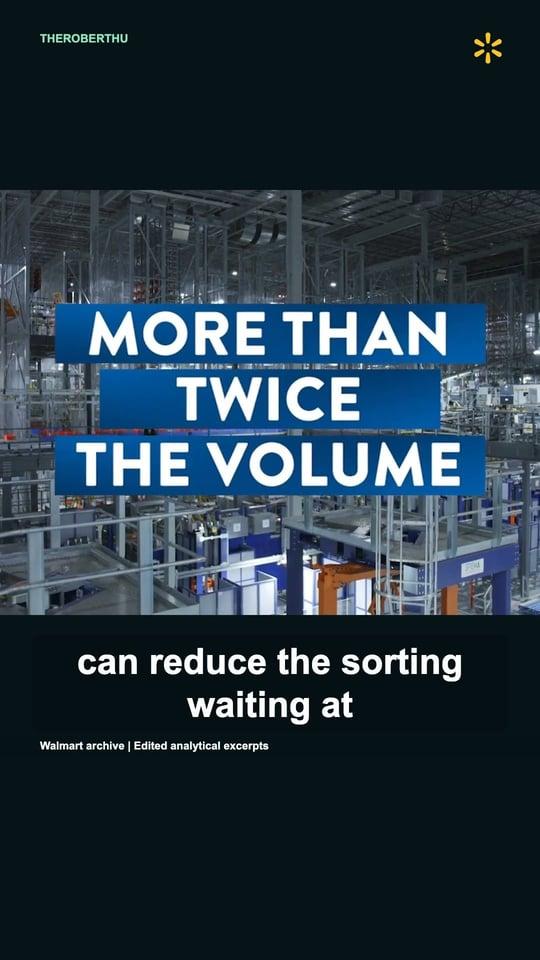
Walmart also says its high-tech perishable centers can process more than twice the volume of a traditional facility. That is the company’s capability claim. It does not tell us the cost of each pallet, or the financial return after equipment, refrigeration and maintenance.
Back to the handoff
The case’s journey ends on a shelf, not at the edge of the conveyor. The clever part of the automation is planning for the work that comes next. A faster machine becomes more valuable when it hands the next person a simpler job.
Chapters
Each chapter opens the video on YouTube at that moment.
Sources
The sources cited in the video, alongside Walmart’s official perishable footage. The more-than-2x processing comparison is Walmart’s capability claim, not an audited return. The weight, dimensions and packaging-type inputs come from Walmart’s explainer footage shown in the video.
Watch the full documentary
2 min 34 sec on YouTube.
Written by Robert Hu; narration uses his authorized AI voice. Brief muted Walmart archive excerpts and analytical frames are directly analyzed with original narration and labeled explanations. No Walmart sponsorship or confirmed footage license. The thumbnail is an editorial composite with Robert Hu, not an on-site visit, employee portrait, interview or independent product test. Music: “Filaments” by Scott Buckley, CC BY 4.0.