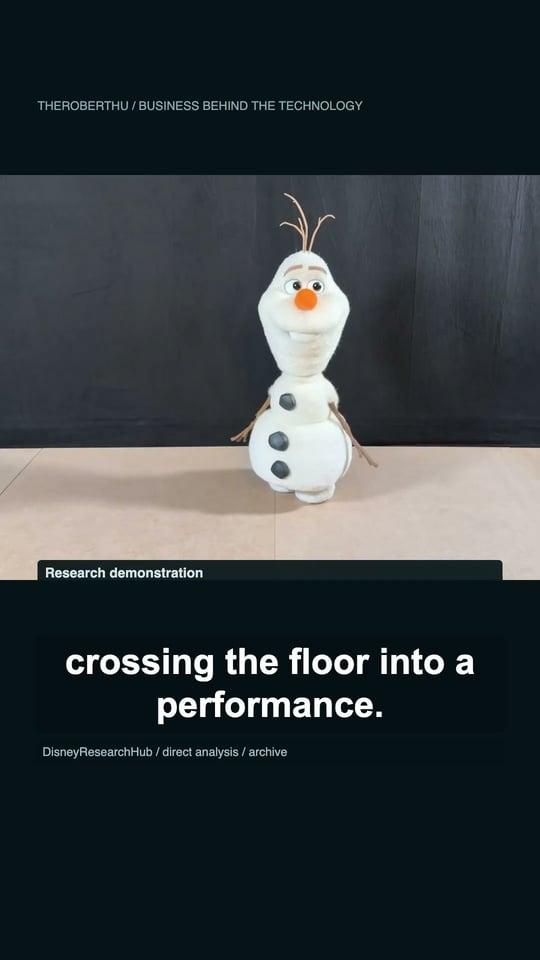
Disney built a walking Olaf. Watch the heel-toe movement from the film. Animators already know how Olaf walks. The harder job was making the engineering behind the walk disappear, so a robot could carry the character into the real world.
Underneath the costume
Disney Research’s paper describes a robot 88.7 centimeters tall that weighs 14.9 kilograms. Olaf’s legs have to hide inside a small body, so the team used an asymmetric leg mechanism with six degrees of freedom and concealed it under a soft foam skirt. The skirt keeps the silhouette and creates the illusion that Olaf’s feet move freely beneath him. Linkages let small motors drive the arms, mouth and eyes from wherever there is room.
Balance and human-directed performance
The round body, small feet and enormous head make Olaf recognizable. They also make him hard to balance. Imagineering uses deep reinforcement learning to teach the robot to imitate artist-provided motion in simulation, so the machine stays upright while keeping the familiar rhythm.
A person still directs the performance. In the research system, Olaf is puppeteered through a remote interface, and an animation engine turns those commands into inputs for the learned controllers, along with triggered animations and audio. The movement is learned. The performance is human-directed.
A snowman’s heat problem
Olaf’s large head sits on a slim neck, and the small motors holding it up work hard as the character looks around. That creates a real risk of overheating, which the costume makes worse. A winter character has a very practical heat problem.
The researchers fed actuator temperatures into the control policy and rewarded thermal safety, so as heat builds the robot can shift its posture to reduce the load. The paper reports that in extended deployments the thermal reward prevented overheating with no noticeable effect on the performance. Keeping the character convincing means respecting the machinery’s limits.
The quieter-footstep tradeoff
A machine can make the right movement and still sound mechanical. Because harsh footsteps break the illusion, the researchers added a training reward for gentler foot impacts. Over a five-minute hardware run, it cut the mean sound level by 13.5 decibels while largely preserving how closely the robot followed the animation. Shape, motion, heat and sound all have to work together.
A park appearance has operating limits
World of Frozen opened at Disney Adventure World, the reimagined second park at Disneyland Paris, on March 29, 2026. Olaf appears in A Celebration in Arendelle, a daytime show on Arendelle Bay, as a robotic character created by Walt Disney Imagineering. Disney’s own opening announcement adds the caveat: depending on weather or technical constraints, Olaf may appear as a puppet.
A successful walking demonstration is one piece of the experience. Delivering it reliably, show after show, is the next challenge. The research footage in the video includes archive and pre-opening material, so it does not show what any given visit will include.
Back to that first step
For Olaf, even a footstep has to stay in character. The engineering only succeeds when nobody notices it.
Chapters
Each chapter opens the video on YouTube at that moment.
Sources
The four sources cited in the video. The 13.5 dB footstep result comes from the research paper’s hardware test, not a park measurement. The research footage includes archive and pre-opening material and does not guarantee what appears in the park.
- Olaf: Bringing an Animated Character to Life in the Physical World (DisneyResearchHub research film)December 19, 2025
- Olaf: Bringing an Animated Character to Life in the Physical World (Disney Research paper, arXiv)Version 2, April 2, 2026
- Walt Disney Imagineering Brings ‘Frozen’ Olaf Robotic Character to Life (The Walt Disney Company)November 24, 2025
- Disneyland Paris Unveils Disney Adventure World and Opens World of Frozen (The Walt Disney Company)March 29, 2026
Watch the full documentary
2 min 24 sec on YouTube.
Written by Robert Hu; narration uses his authorized AI voice. Brief official DisneyResearchHub research excerpts and analytical frames are used with original commentary, with source audio removed. Mechanical cutaways and research comparisons are labeled. Archive demonstrations do not guarantee park availability. Independent analysis, with no Disney endorsement. The thumbnail uses Disney Research archive images in an editorial layout; it does not document a visit, interview or product test. Music: “Filaments” by Scott Buckley, CC BY 4.0.