Starbucks dropped its ChatGPT app on April 15. Type @Starbucks, I want something warm for a slow morning and ChatGPT recommends a drink, customizes it, and hands you off to the Starbucks app to pay. It's the cleanest execution of conversational commerce we've seen.
The architecture matters more than the product. Discovery happens in ChatGPT. Checkout happens in Starbucks. Loyalty data stays with Starbucks. That three-part split is the playbook marketplace sellers should be studying, even if you'll never build your own ChatGPT app.
Key Takeaways
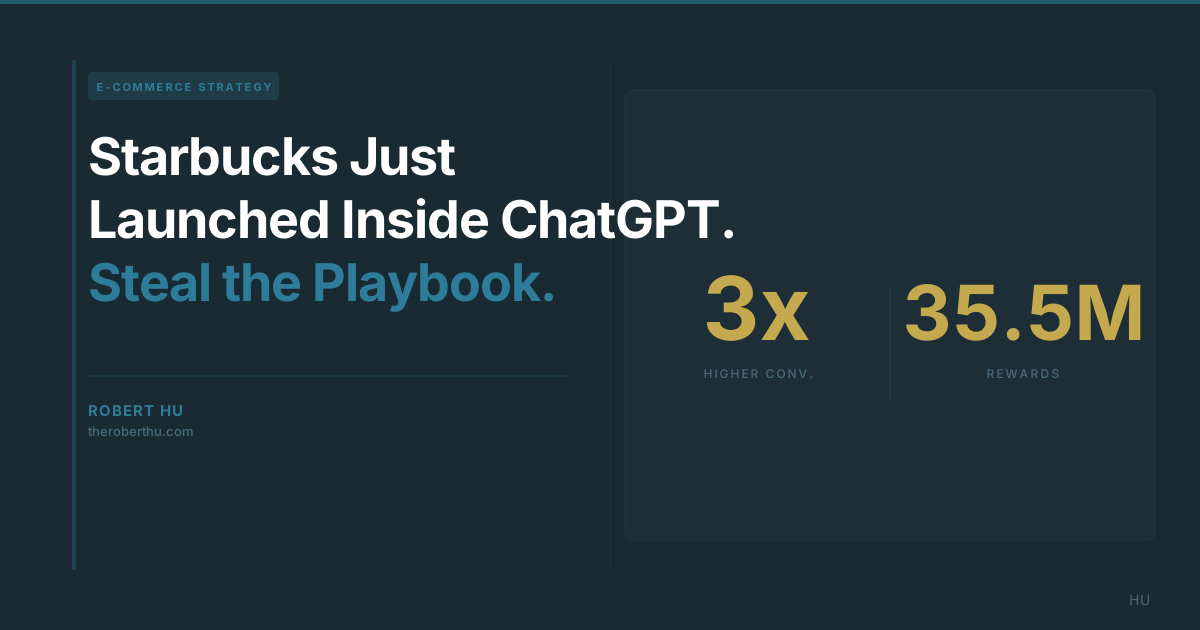
- 3x lower conversion from OpenAI's Instant Checkout compared to redirect flows. Starbucks skipped the failed model entirely and went straight to redirect.
- 35.5 million Starbucks Rewards members protected. Loyalty data stays with Starbucks, not OpenAI, even when the shopper discovered the drink through ChatGPT.
- Discovery is moving upstream of the product. Shoppers now start with a feeling or craving, not a keyword. Your listings need to answer mood and context, not just features.
- You don't need to build a ChatGPT app to benefit from this shift. You need to understand what Starbucks just proved: the AI is the discovery layer, but the transaction stays home.
What Did Starbucks Actually Launch?
The app lives inside ChatGPT. A user types @Starbucks followed by a natural-language request like "something sweet to wake me up" or "a cold drink I can sip during my afternoon meeting." ChatGPT generates a recommendation, suggests customizations (milk type, syrup, size), and then redirects to the Starbucks app for checkout.
The checkout flow is Starbucks, not OpenAI. The Rewards points are Starbucks. The customer data is Starbucks. ChatGPT handled discovery and recommendation. Starbucks kept everything downstream of that.
This is the opposite of what OpenAI originally pitched with Instant Checkout. The original vision was conversations ending in purchases inside ChatGPT itself. Users would never leave the chat. OpenAI would handle payment, and merchants would fulfill.
Starbucks looked at that model and said no.
Newsletter
Follow the research
Research notes and analysis on how AI, digital transformation, product discovery, and customer behavior are changing commerce.
Subscribe to Hu's Weekly HootWhy the Redirect Flow Matters
OpenAI's Instant Checkout was reporting conversion rates roughly 3x lower than redirect flows. Users liked researching in ChatGPT but didn't trust it as a checkout surface. Real-time inventory, tax calculations, shipping estimates, return policies: all of it got messy when the transaction happened inside a chat window.
OpenAI scaled back Instant Checkout earlier this year after the data came in. The pivot was explicit: ChatGPT would be the discovery layer, merchants would handle checkout in their own branded environments.
Starbucks skipped that entire painful iteration. They launched directly with the model that was already proven to work. Discovery in ChatGPT, transaction at home.
The result is a user flow where conversion is protected (because checkout happens in a trusted app), loyalty data is protected (because Rewards tracking stays with Starbucks), and the customer relationship is protected (because Starbucks, not OpenAI, has the email, phone number, and purchase history).
The Bigger Shift: Discovery Is Moving Upstream of the Product
Here's what most marketplace sellers will miss. The Starbucks ChatGPT app isn't really about Starbucks. It's evidence of a structural shift in how shoppers start the buying journey.
Traditional discovery: customer has a problem, searches for a product, evaluates options, buys. The query is the entry point. Keywords drive the match.
Conversational discovery: customer has a feeling or craving, describes it to an AI, receives a recommendation, follows through to purchase. The mood is the entry point. Context drives the match.
"Something warm for a slow morning" is not a keyword. It's a vibe. A feature-based search engine can't parse it. Amazon's keyword-matching algorithm can't match it. But Sparky can. Rufus can. ChatGPT can. Any AI with natural language understanding can.
This is the discovery layer moving upstream of the product. The shopper is no longer describing what they want in product terms. They're describing their state of mind, and the AI is translating that into product recommendations.
What Does "Starting With a Feeling" Mean for Your Listings?
If the entry point is mood and context, your product listings need to contain mood and context language. Features alone won't trigger the match.
Take an example. A shopper asks ChatGPT: "I'm looking for a gift for my 6-year-old nephew who loves dinosaurs and hates sitting still." That query contains four dimensions the AI will try to match against:
- WHO: 6-year-old nephew
- WHEN: Gift occasion
- WHY: Loves dinosaurs, hates sitting still (needs engagement)
- WHAT: Something that ties those together
A listing that says "Dinosaur Toy Set, 12 Pieces, BPA-Free Plastic, Ages 3+" has the product category but none of the context. The AI can't confidently match it to an active 6-year-old who loves dinosaurs.
A listing that says "Interactive dinosaur excavation kit for active kids ages 5-8, hands-on STEM learning, includes 6 dino figures and digging tools, perfect gift for young paleontologists" answers the mood, the age, the use case, and the gift context. That's a match.
This is the same Generative Engine Optimization framework that applies on Amazon and Walmart. Conversational AI assistants like ChatGPT are extending it beyond marketplaces. The shoppers asking ChatGPT for recommendations are the same shoppers who eventually land on your Amazon listing. If the listing doesn't match the mood that triggered the search, the conversion fails.
The Data Flywheel Advantage
Here's why Starbucks kept loyalty data at home. Their 35.5 million Rewards members are the asset that compounds over time. Every purchase, every customization, every visit feeds a database that makes the next recommendation better. If Starbucks had handed that data to OpenAI, they'd be renting their own customer relationship back.
Marketplace sellers have a similar flywheel. On Amazon, your asset is review velocity, buying history, and Subscribe & Save subscribers. On Walmart, it's review quality, repeat purchase data, and Walmart+ opted-in customers. Each of those is a compounding advantage that AI assistants cannot replicate or take away.
The implication is simple. You don't need to own the discovery layer to win. You need to own the transaction, the data, and the customer relationship. Let AI handle the upstream. Protect what happens downstream.
How Should Marketplace Sellers Apply This?
You probably won't build your own ChatGPT app. Most brands at $100K to $2M don't have the budget, engineering team, or OpenAI partnership tier. But the Starbucks playbook translates directly into moves you can make on Amazon and Walmart this week.
1. Rewrite your listings for mood and context, not just keywords. Audit your top 5 SKUs. Ask yourself: if a shopper asked ChatGPT or Rufus about a feeling or situation your product solves, would the AI find your listing? If your bullets only describe features, the answer is no. Add the mood, the use case, the emotional context. This is the foundational listing strategy for AI-driven discovery.
2. Let AI handle discovery, let marketplaces handle transaction. Your listings on Amazon and Walmart are your checkout surfaces. ChatGPT, Rufus, and Sparky are your discovery surfaces. You don't need to fight that division. You need to optimize for it. Accept that AI will handle upstream discovery and invest in making sure your listing converts once the shopper arrives.
3. Protect your customer data and reviews as compounding assets. Every review on your Amazon listing is a signal Rufus uses for future recommendations. Every repeat buyer on Walmart is a retention asset that AI can't commoditize. Invest in customer experience, post-purchase follow-up, and brand-specific touchpoints that keep buyers coming back to you, not just to the marketplace.
4. Monitor which AI surfaces send traffic to your listings. Amazon now shows Rufus-influenced traffic separately in some reports. Walmart's search analytics will eventually separate Sparky-driven clicks. Track these channels the same way you track PPC and organic. They're not a sideshow. They're the fastest-growing source of high-intent traffic on both platforms.
The Bigger Picture
Starbucks just showed what the next decade of commerce looks like. AI handles the messy human language of what you want. Brands handle the clean, reliable work of fulfilling that want. Discovery is upstream. Transaction stays downstream. Loyalty and data stay with the brand that owns the relationship.
For marketplace sellers, the lesson is simple. You can't own ChatGPT. You don't need to. You need to make sure your listings are ready for shoppers who start the buying journey with a feeling, not a keyword. And you need to protect the downstream assets (reviews, loyalty, repeat buyers) that compound over time.