The clothes go into the basket. A list of items appears on the screen. Nobody scans each garment’s barcode.
How the basket gets read
The method is radio frequency identification, or RFID. Tags on the products carry identifiers that a reader can pick up by radio, so the checkout can identify tagged items without anyone finding and turning a printed label. The video follows an imagined black shirt in your size through that process. It is an illustration, not a tracked customer order.
The tag starts before checkout
A store full of shirts is no comfort if nobody can find the right one. The same identification can help the business know which items it has and where they are. In an October 2018 presentation, Fast Retailing’s Takuya Jimbo described attaching RFID tags to all products at the point of manufacture, to see inventory across factories, warehouses and stores. He also said the tags had greatly improved the cash desk and made instant inventory counts possible in stores and warehouses.
Checkout is the moment the customer notices. The inventory information is useful long before it.
What a tag cannot fix
Someone still has to attach the tag, connect its identifier to the right product and handle the exception when the information is wrong. RFID changes where the work sits. It does not remove the need for accurate product data.
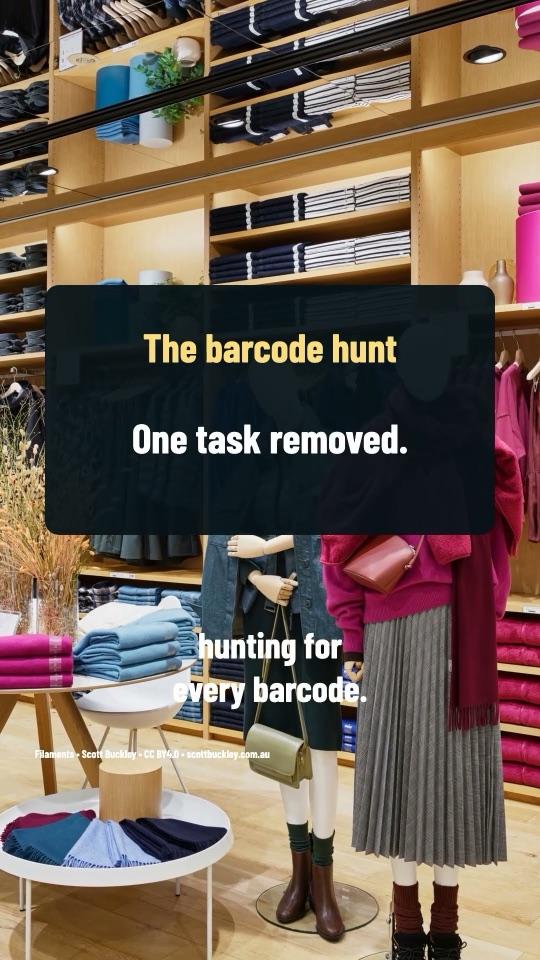
The barcode hunt
Compare ordinary self-checkout. Find the label, turn the item, find the next label, repeat. The shopper becomes the cashier, without the employee discount.
In UNIQLO Indonesia’s March 2024 demonstration, the shopper still checks the list and pays. The barcode shown on the phone is the membership code, a separate job from identifying each garment.
The part worth borrowing
The clever move is removing a repeated task while keeping the decisions that still need to happen. Before buying a faster machine, ask whether the step needs to exist in its current form. That question travels further than the hardware.
Chapters
Each chapter opens the video on YouTube at that moment.
Sources
The three sources cited in the video. The Fast Retailing presentation is from 2018 and describes the supply chain reforms of that time, not current operations in every market. The checkout analysis is based on UNIQLO Indonesia’s March 2024 demonstration, and no speed or savings figure is claimed.
- Supply chain reform presentation by Takuya Jimbo (Fast Retailing, PDF)October 11, 2018
- About RFID technology (Impinj)Cited in the video
- UNIQLO Indonesia RFID checkout demonstration (YouTube)March 2024
Watch the full documentary
1 min 42 sec on YouTube.
Written by Robert Hu; narration uses his authorized AI voice clone. Brief muted excerpts and frames from UNIQLO Indonesia’s March 2024 demonstration are shown with original commentary. Store photographs come from the UNIQLO / Fast Retailing Photo Library, offered for free use. Illustrative shopping footage by Ron Lach and Anvar Tushakov on Pexels does not show UNIQLO stores, employees or a documented customer journey. Tag and workflow graphics are simplified original illustrations, not drawings of proprietary equipment. The thumbnail is an AI-assisted editorial composite with Robert depicted in a fictional retail setting; it does not document a store visit, employment or a product test. Music: “Filaments” by Scott Buckley, CC BY 4.0. Independent commentary; no sponsorship or endorsement.