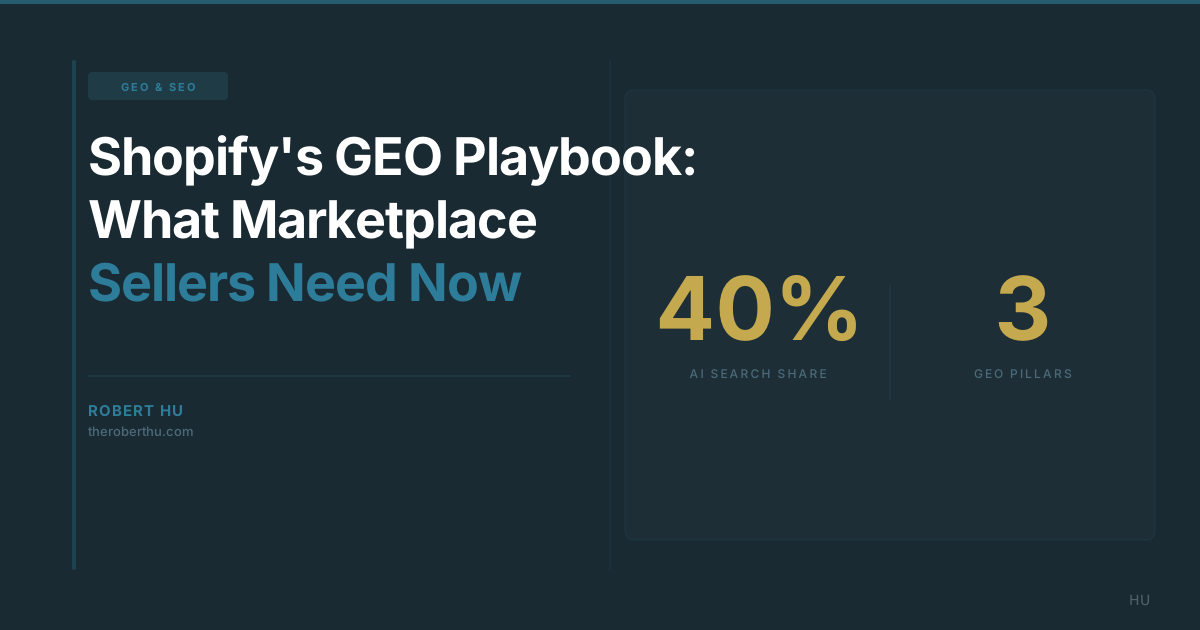
Shopify just published their definitive guide to Generative Engine Optimization, and the three pillars they identify are exactly right: SEO fundamentals, brand authority, and data quality. Every e-commerce brand needs to internalize this framework. But if you sell on Amazon or Walmart, there is a significant gap between what Shopify describes and what actually works for your business.
Amazon Rufus and Walmart Sparky are not crawling your Shopify store or your brand website. They are reading your product detail pages, your A+ Content, your backend search terms, your customer reviews, and your structured catalog attributes. The brands that translate Shopify's GEO framework into a marketplace-specific strategy will have a massive advantage. Most sellers do not even know this shift is happening yet.
Key Takeaways
- Amazon Rufus now handles over 13% of Amazon searches using semantic AI, not keyword matching. Your listing copy and catalog completeness are your primary GEO levers.
- Shopify's three GEO pillars (SEO fundamentals, brand authority, data quality) apply to marketplace sellers, but the execution is entirely different. Rufus does not read your website.
- Marketplace sellers have a structural advantage: Amazon and Walmart already enforce the structured catalog format that AI agents need. DTC brands have to build that from scratch.
- Brands with complete catalog data, semantically clear listing copy, and strong review signals will be the first winners of AI-driven product discovery across Amazon and Walmart.
What Did Shopify Actually Get Right?
Shopify's GEO playbook (published February 2026) frames the challenge accurately: AI shopping agents are becoming a primary discovery channel, and the brands that prepare now will have a meaningful head start. (Source: Shopify)
Pillar 1: SEO Fundamentals. Traditional search still matters because AI agents pull from existing indexes. Clean technical infrastructure, quality content, and proper crawlability are table stakes. An AI assistant that cannot access your content cannot recommend you.
Pillar 2: Brand Authority. AI systems evaluate trust signals across the entire internet, not just your website. Press coverage, community presence, and reputation signals help AI agents decide whether you are a brand worth recommending or an unknown commodity.
Pillar 3: Data Quality. Direct access to accurate, structured, real-time product data: inventory, pricing, attributes, and variant structure. AI agents that cannot confidently describe your product will not recommend it.
Every one of these pillars applies to marketplace sellers. The execution is completely different.
Newsletter
Follow the research
Research notes and analysis on how AI, digital transformation, product discovery, and customer behavior are changing commerce.
Subscribe to Hu's Weekly HootWhat Is Missing for Amazon and Walmart Sellers?
Shopify's playbook is built around the DTC storefront model. Fix your title tags. Build external links. Implement structured data markup on your product pages. All correct, and all largely irrelevant if your products live on Amazon or Walmart.com.
Here is the fundamental difference. ChatGPT and Perplexity pull from the open web. Google AI Overviews index your content like a traditional crawler. Amazon Rufus and Walmart Sparky operate from closed ecosystems. They evaluate products based on what lives inside the platform, not what is on your website.
Rufus is not visiting your brand site. It is reading your product title, your bullet points, your A+ Content, your backend search terms, your customer Q&A, your review data, and your catalog attributes. Sparky does the same on Walmart. The signals are different. The levers are different. The strategy has to be different.
This is not a criticism of Shopify's playbook. It is genuinely useful for DTC brands. But if you follow it as written and sell primarily on Amazon, you are optimizing for the wrong system.
How Do Amazon Rufus and Walmart Sparky Evaluate Products?
Amazon Rufus has reached 250 million shoppers and now handles more than 13% of searches on the platform. It is a semantic AI built on Amazon's COSMO framework. Rufus evaluates products based on contextual fit to the shopper's query, not simple keyword overlap.
When a shopper asks "What is the best protein powder for women over 40 who do not like chalky textures?", Rufus does not just match keywords. It evaluates your listing for how completely and clearly it answers that kind of question. Generic copy loses. Specific, use-case-driven copy wins.
The signals Rufus weights most heavily:
- Listing copy clarity. Can Rufus extract a clear, factual answer from your title and bullet points about who this product is for and what it does?
- Catalog completeness. Are all required and optional attribute fields filled in? Missing data is ambiguity. Ambiguity means Rufus picks a competitor.
- Review sentiment and depth. Rufus reads reviews for context. A product with 200 reviews averaging 4.7 stars with substantive feedback will outperform one with 1,000 shallow reviews averaging 3.9 stars.
- Brand consistency. Rufus uses entity matching. If your brand name is spelled differently across listings, you create ambiguity that hurts your recommendation rate.
Walmart Sparky operates similarly, with an important distinction: Sparky now supports Sponsored Prompts, meaning paid visibility inside AI conversations is already live. Organic Sparky optimization follows the same logic as Rufus. But Walmart's catalog taxonomy is its own system with its own attribute requirements, so a direct copy-paste from your Amazon catalog is not the right approach.
How to Translate Shopify's Three Pillars for Marketplace GEO
Here is how each of Shopify's three pillars maps to what marketplace sellers actually control.
Pillar 1: SEO Fundamentals, Translated
For DTC brands, SEO fundamentals mean title tags, sitemaps, server-side rendering, and clean robots.txt files. For marketplace sellers, your product title is your title tag. Your backend search terms are your meta keywords. Your A+ Content is your long-form body copy. And the "clean crawl" equivalent is a complete, consistent product detail page with no missing attributes.
Shopify's recommendation to audit product pages for missing information is exactly the right audit for your Amazon catalog. Run your catalog through a completeness check. Every missing attribute is a GEO penalty.
Shopify also flags a tactic worth copying: use literal descriptions, not marketing speak. A product titled "Walk on Clouds" tells Rufus nothing. "Men's Memory Foam Running Shoes with Arch Support, Size 8-13" gives Rufus exactly what it needs to recommend you to the right shopper. For a full breakdown of how to optimize your listings for Rufus, the core moves are semantic clarity and attribute completeness.
Pillar 2: Brand Authority, Translated
For DTC brands, brand authority means press coverage, external backlinks, and community engagement. For marketplace sellers, brand authority lives primarily inside the platform.
Your Amazon Brand Registry status, your brand Storefront completeness, your average star rating, and the consistency of your brand entity across listings are the trust signals Rufus evaluates. A brand with registered trademarks, complete A+ Content, a well-built Storefront, and consistent naming reads as authoritative to platform AI.
There is also an external component that transfers. If your brand appears in product review publications, "best of" roundups, and comparison articles, that content matters to some degree. Rufus is not completely closed. It uses external signals to validate brand legitimacy. A brand with zero presence outside Amazon will face more resistance than one with meaningful external mentions.
This is why Robert Hu's approach to Amazon brand building combines platform optimization with earned media. Both signal channels matter for long-term AI discoverability on marketplace platforms.
Pillar 3: Data Quality, Translated
This is the pillar where marketplace sellers have the most immediate leverage and the clearest action path.
Shopify talks about direct API access to real-time product data: inventory, pricing, and attributes. For marketplace sellers, this is your product catalog in Amazon Seller Central or Walmart Seller Center. The data quality principle is identical. The execution is platform-specific.
Specific catalog data fixes that directly impact Rufus and Sparky recommendations:
- Category assignment. Never assign a product to "Other" or a vague parent category. Rufus and Sparky use taxonomy to filter recommendations. Generic categorization means you miss category-filtered AI queries entirely.
- Variant structure. Color, size, and material variants should be modeled correctly under a single parent ASIN. Fragmented variants create matching confusion for AI engines.
- UPC and GTIN accuracy. Catalog AI cross-references product identifiers. Incorrect or missing GTINs create data integrity issues that suppress recommendations.
- Attribute completeness. Fill every available attribute field, not just the required ones. Optional attributes create the differentiation that lets Rufus match your product to specific shopper queries.
Why Marketplace Sellers Have a Structural GEO Advantage
Here is what most brand owners miss when they read articles like Shopify's playbook: marketplace sellers are already operating inside a structured data system.
DTC brands optimizing for GEO have to build structured product data architecture from scratch. They need to implement schema markup, create structured feeds, and build the infrastructure to surface clean product data to AI agents. This takes months and real technical investment.
Amazon and Walmart have already enforced that structure on your catalog. The taxonomy exists. The attribute schema exists. The data format that AI agents need is already the format your products live in. You are not building the foundation. You are cleaning and optimizing a foundation that already exists.
The brands that act on this in the next six to twelve months will build a real advantage. Once Rufus learns that your brand consistently surfaces accurate, complete, well-matched results for shoppers, that trust compounds. The AI recommendation flywheel works exactly the same way organic search authority works. Build it now, before most of your competitors realize the game has changed.
What Should Amazon Sellers Do This Quarter?
These are the highest-leverage actions for marketplace GEO, prioritized by impact.
- Run a catalog completeness audit. Pull your full catalog and flag every ASIN with missing bullet points, empty descriptions, absent attributes, or generic category assignments. These are your highest-leverage fixes and the fastest way to improve Rufus eligibility.
- Rewrite your titles for semantic clarity. Replace "Best [Product] for [Vague Claim]" with specific, factual descriptions. Include the use case, primary benefit, and key specifications. Keyword density is secondary to factual clarity for Rufus.
- Restructure your bullets as answers to AI questions. "Who is this for?" "What problem does it solve?" "How is it different from alternatives?" Rufus surfaces products whose copy directly answers likely shopper follow-up questions.
- Audit your brand entity consistency. Is your brand name identical across every listing, your Storefront, your A+ Content, and your product images? Inconsistency creates entity ambiguity that costs you AI recommendations.
- Build A+ Content around use-case scenarios. AI agents pull from A+ Content when evaluating detailed queries. Generic feature lists underperform use-case narratives that match real shopper intent.
Frequently Asked Questions
What is generative engine optimization for e-commerce?
Generative engine optimization (GEO) for e-commerce is the practice of structuring product content and catalog data so that AI shopping tools like Amazon Rufus, Walmart Sparky, ChatGPT, and Perplexity can accurately understand, evaluate, and recommend your products. Unlike traditional SEO, GEO focuses on AI readability: completeness, semantic clarity, and entity consistency rather than keyword density and backlink volume.
What is GEO for Amazon sellers?
GEO for Amazon sellers means optimizing your product listings and catalog data to appear in AI-generated shopping recommendations from Amazon Rufus. The core signals are catalog completeness, listing copy clarity, review sentiment, and brand consistency inside Amazon's ecosystem. External web signals have minimal direct impact on Rufus recommendations, which is why DTC-focused GEO tactics do not translate directly to Amazon.
How does Amazon Rufus evaluate products differently from Google?
Google evaluates your website using a traditional crawl of external web pages, backlinks, and on-page content. Amazon Rufus evaluates your product using internal catalog data: listing copy, category taxonomy, attribute completeness, review sentiment, and brand consistency within Amazon's closed platform. Your website SEO does not move your Rufus ranking.
Why do marketplace sellers have an advantage in GEO?
Marketplace sellers already operate within a structured catalog system enforced by Amazon or Walmart. That catalog structure is exactly the data format AI agents need to evaluate and recommend products. DTC brands have to build that structure from scratch. Marketplace sellers just need to clean and optimize the infrastructure that already exists.