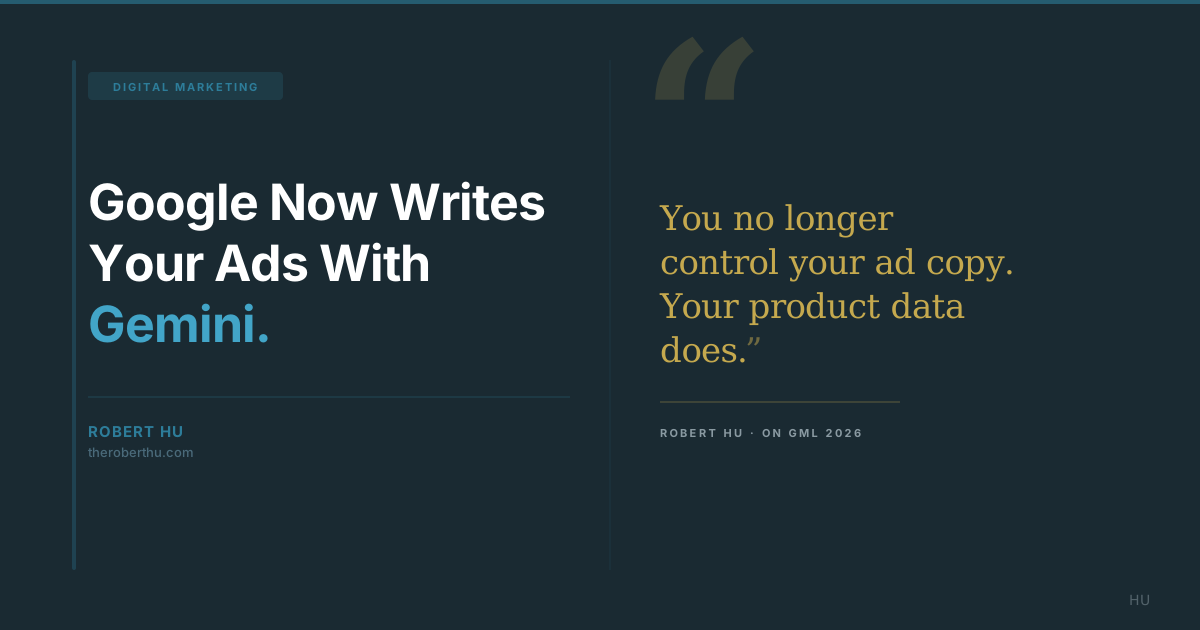
Google Marketing Live 2026 happened on May 20, and most of the coverage focused on the 42 ad launches aimed at agencies and PPC managers. One announcement matters more for marketplace sellers than all the rest combined: Gemini now writes your shopping ad descriptions. Not your title. Not your bid. The actual description copy a buyer reads, generated by Gemini, pulled from your product data and website, and matched to the specific query the buyer typed.
Here is why that matters. For the last year, the argument for GEO was about organic visibility: get recommended by Rufus, Sparky, ChatGPT, and Perplexity. GML 2026 just extended that argument into paid. When Gemini writes your ad copy from your product data, your data quality becomes your ad quality. Clean, structured, complete product data produces sharp, query-matched ad copy. Thin or messy data produces generic Gemini summaries that convert worse. You no longer fully control your ad copy. Gemini does. And Gemini writes from whatever data you gave it.
This is the same dynamic covered in why GEO still wins even as ChatGPT opened self-serve ads. Paid AI placement does not replace GEO. And now, even inside paid, the GEO foundation is what wins.
What changed for product ads at GML 2026
The Gemini-written shopping ad format replaces the static product description with one written on the fly for each query. If a buyer searches in AI Mode for "the perfect espresso machine for a small kitchen," Gemini writes ad copy explaining the specific features of each option that matter for a small kitchen, pulled from each advertiser's product data and website content. The ad answers the query in the buyer's own language instead of just displaying the product with a generic title and price. The same listing surfaces a different sentence depending on what the buyer asked.
Google also introduced a conversational ad format inside AI Mode. Some ad units now let a buyer ask a question directly inside the ad and get a response pulled from the advertiser's website. This is a custom AI agent living inside the ad unit. The quality of the answer depends entirely on the quality and structure of the data on the advertiser's site. A site with clean, machine-readable product information gives the in-ad agent good material to work with. A site with thin or image-locked product data gives it nothing to pull from. Dan Taylor, Google's VP of Global Ads, described the broader direction as agents that "talk to one another and carry each other's content." The buyer's agent reads the seller's content. The seller's content has to actually be readable.
Newsletter
Follow the research
Research notes and analysis on how AI, digital transformation, product discovery, and customer behavior are changing commerce.
Subscribe to Hu's Weekly HootWhy your product data now controls your ad copy
The instinct is to treat this as a paid media problem to hand to a PPC manager. That instinct is wrong. The PPC manager controls the bid, the budget, and the targeting. The PPC manager does not control the ad copy anymore. Gemini writes the copy. Gemini writes it from your product data. The lever that determines ad copy quality is upstream of the ad account. It lives in your listing data and your DTC product pages.
This is the exact same data quality that determines organic AI visibility. The 6-dimension GEO framework, WHO, WHEN, WHERE, WHY, WHAT, and AI Retrievability, scores how well an AI engine can read and match your product data. A listing that scores high on that framework gives Gemini rich material to write a query-matched ad. A listing that scores low gives Gemini a generic title to paraphrase. The same data that gets you recommended organically now gets you better paid ad copy. One foundation. Two payoffs.
The brands that have been doing GEO work are about to get an unearned advantage in paid, because their data was already structured for AI to read. The brands that ignored GEO are about to discover that their paid ads underperform not because of bidding strategy but because Gemini has nothing good to write from. The cost of thin product data just moved from "you do not get recommended organically" to "you do not get recommended organically AND your paid ads convert worse."
What marketplace sellers should audit this week
- Audit your DTC product page data. The in-ad agent and the Gemini ad descriptions pull from your website. If your product specs, use cases, and attributes are in clean text (not locked in images or PDFs), Gemini has good material. If they are buried in graphics, Gemini writes generic copy. Move product data into structured, machine-readable text before you raise a single bid.
- Check your structured data and schema. Product schema, FAQPage schema, and complete attribute markup give Gemini explicit signals to write from. This is the same AI Retrievability work that lifts your organic AI visibility. Run your top product pages through a schema validator. Fix what fails. Add what is missing.
- Score your top SKUs against the 6-dimension framework. The same WHO/WHEN/WHERE/WHY/WHAT/AI Retrievability scoring that determines organic recommendations now determines how well Gemini can write your paid ad copy. Listings that score high give Gemini query-matchable material. Listings that score low give Gemini a title to paraphrase into a generic sentence.
- Do not pour budget into AI Mode ads before fixing the data. Bidding into a Gemini-written ad format with thin product data is paying for copy that will not convert. Fix the data foundation first, then scale spend into the format.
The pattern across every platform
GML 2026 confirms a pattern visible across every major platform. Amazon reads your data to recommend you through Rufus and Alexa for Shopping. Walmart reads your data to recommend you through Sparky. ChatGPT and Perplexity read your data to recommend you in answers. And now Google reads your data to write your paid ad copy. The common thread is that product data quality is the input every AI surface depends on, paid and organic, marketplace and search. The brands that treat their product data as their most strategic asset win across all of them. The brands that treat it as a one-time setup task lose across all of them. This is the same direction the agentic commerce layer is heading, where buying agents will read the same data to make decisions on the buyer's behalf.
Closing
Gemini writing your ad copy is not a paid media story. It is a data quality story. The GEO foundation that earns organic AI recommendations now also produces better paid ad copy. One data layer feeds both. The brands that built the foundation get the compounding advantage across paid and organic simultaneously. The brands that skipped it now have two problems for the price of one.
The GEO vs SEO companion post covers what to stop doing.
Frequently Asked Questions
Does Gemini really write my Google ad copy now?
Yes. At Google Marketing Live 2026 on May 20, Google confirmed that Gemini now generates shopping ad descriptions for AI Mode queries, pulling from your product data and website content. The copy a buyer reads is written by Gemini, matched to that buyer's specific query, not a static description you wrote once.
Can I still control my ad copy, or is it fully automated?
You control it indirectly. You no longer write the literal sentence Gemini shows the buyer. You control what Gemini has to work with: your product data, your attribute completeness, your DTC site content, and your structured markup. Whatever you give Gemini becomes the material it writes from. Thin data produces thin copy. Rich data produces sharp copy.
Is this a paid media issue or a GEO issue?
It is a GEO issue with paid media symptoms. The PPC manager controls bid, budget, and targeting. The PPC manager does not control the ad copy anymore. The lever for ad copy quality lives upstream in your listing data and DTC product pages. The same GEO foundation that drives organic AI recommendations now drives paid Gemini-written ad copy.